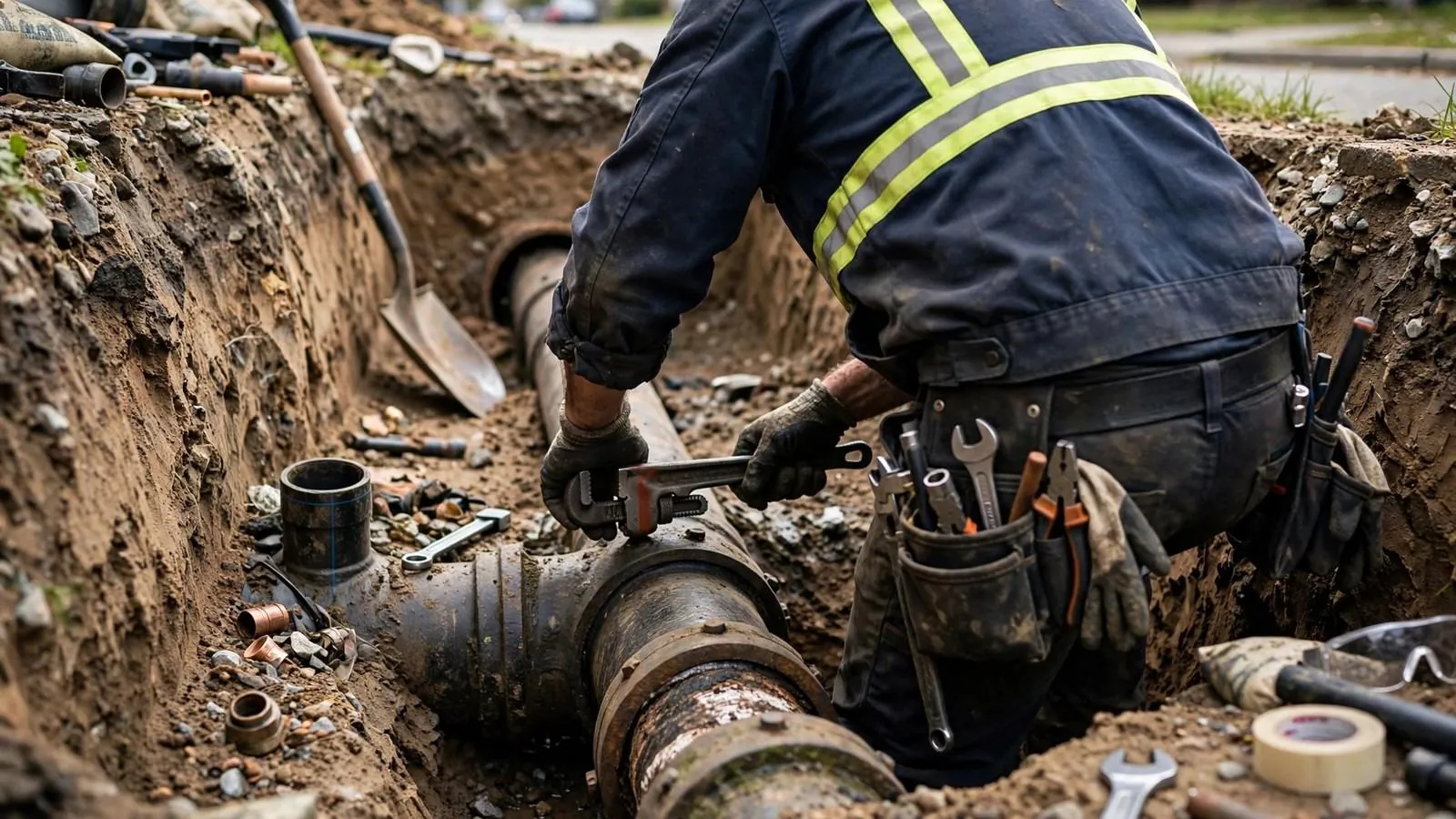
Cast iron was a common choice for drain and sewer pipe for decades, and many older homes still have it in the ground under the basement floor or between the house and the street. It is strong and quiet, but it does not last forever. Inside, the metal rusts and builds up scale, and outside, soil and roots work on the joints.
Homeowners usually find out when a drain slows, a toilet gurgles or sewage backs into a floor drain. This guide explains how cast iron fails, how a plumber confirms it and how the repair options compare, so you can ask the right questions before you sign off on a dig.
How cast iron fails from the inside out
Rust is the first problem. Water and waste slowly corrode the inner wall, and flakes and scale build up in rough lumps that narrow the pipe and catch paper and grease. Over time the wall thins, and a thin spot can crack from soil pressure or a heavy load above it.
Joints are the second weak point. Older cast iron was often joined with lead and oakum at hub-and-spigot fittings, and those joints can loosen and open. Small roots find the gap, enter and grow into a mass that snags everything that follows.
A belly is a low spot where the line has sagged. It is usually a soil problem, not a pipe-material problem, and it holds water and waste instead of letting it flow. A belly makes repeated clogs, because solids settle in the dip every time.
Signs the problem is in the sewer line
- Several drains slow down or gurgle at the same time, not just one fixture.
- A basement floor drain or a ground-floor toilet backs up when you run water elsewhere.
- Clogs return within weeks or months after each cleaning.
- You smell sewer gas in a bathroom or the basement, or notice a damp patch on the lawn.
- A plumber's snake keeps hitting something hard or comes back with rusty flakes and roots.
Finding the failure with a camera
A sewer camera inspection pushes a small waterproof camera down a cleanout and records what is in the pipe. It shows scale, cracks, offset joints, roots and bellies, and a locator can mark the depth and position of a problem from above ground. You get an actual picture of the pipe instead of a guess.
Cleaning comes before or after the camera, depending on the blockage. Hydro jetting cuts roots and scale off the wall with high-pressure water, but on thin or cracked cast iron it should be judged by the camera first. Jetting a pipe that is already failing can open a crack or wash away the last bit of support.
Homeowners in Granby and Avon who suspect an old line can use the same approach, starting with a recording of the pipe.
Repair options compared
No single method fits every pipe. The camera and the location of the damage decide which one is realistic.
| Option | Best when | Trade-offs |
|---|---|---|
| Cleaning only | The pipe is sound but roots or scale are catching waste | A temporary fix. Roots and scale return unless the opening is repaired |
| Spot repair with couplings | One section is cracked, offset or collapsed | Needs digging or floor cutting at that spot, and leaves the rest of the old pipe in place |
| Lining (cured-in-place) | The pipe is mostly sound with scale, small cracks or leaking joints | Needs a clean, round pipe, shrinks the bore a little and cannot fix a belly or a collapse |
| Pipe bursting | Long runs of failing pipe with room for entry pits | Needs pits at both ends and works poorly near other buried utilities |
| Full dig-and-replace | The pipe is collapsed, badly bellied or the damage is spread out | The most disruptive, but it gives new pipe at the right slope |
Sewage backing up?
Same-day appointments are offered when available, and the 24/7 line stays open.
What the repair visit looks like
Here is how a typical sewer line repair unfolds, from first call to the final test.
Camera and locate
The line is cleared enough to pass a camera, then the problem is recorded and marked on the surface.
Choose a repair
You see the footage and get the options with a clear price before work starts.
Dig or line
For a dig, utilities are marked first. For lining, the pipe is cleaned and the liner is cured in place.
Test and restore
The line is run with water and checked by camera again, then the trench or floor cut is closed.
Sewage backing up right now
If sewage is coming up
Stop using water, do not flush, and keep people and pets out of the wet area. The Connecticut Department of Public Health says to turn off power if there is standing water or a chance wires can touch it. Call the 24/7 line for a plumber, and call Simsbury Water Pollution Control if you see sewage outside or in the street.
What Simsbury homeowners should know about sewer, septic and digging
Not every Simsbury property is connected to public sewer. The Town says to call the Water Pollution Control Facility at 860-658-3258 to learn whether a property is in the sewer service area, and septic systems fall under the Farmington Valley Health District at 860-352-2333. Find out which you have before you plan any repair, because a septic line failure is handled differently.
On a sewered property, the Town says the pipes inside the building and the lateral to the main belong to the owner, and that lateral repairs must be done by a licensed plumber. Connecticut statute counts lateral sanitary lines as plumbing work. If sewage is visible outside or in the street, report it to the Water Pollution Control Facility, because it may be a public main problem.
Before any digging, call 811 or 1-800-922-4455. State law requires notice at least two full business days before power-assisted digging, a homeowner doing it has to call, and a contractor must call when one is hired. The service is free and failure to call is the largest single root cause of damage to buried lines nationwide, so build those days into your repair schedule.
Frequently Asked Questions
Not all properties in Simsbury are on public sewer. Call the Simsbury Water Pollution Control Facility at 860-658-3258 to confirm whether your address is in the sewer service area. If you are on septic, the Farmington Valley Health District oversees it and private companies service it.
Sometimes. Lining and pipe bursting avoid trenching the whole line, and EPA lists them as trenchless methods. A collapse, a deep belly or a badly cracked section may still need a dig, and the camera footage decides.
Not usually. Insurance Information Institute guidance says sewer backups are not covered by a typical homeowners policy and neither are problems from lack of maintenance. Backup coverage is sold as an add-on, so ask your insurer what yours includes.
There is no fixed number. Soil, water, use and the original joints all matter, and a pipe can look fine on one side of the house and fail on the other. A camera inspection tells you the current condition.
Not enough long-term evidence exists to say. EPA research notes there is little quantitative evaluation of how lining performs over time, so ask the installer about materials, what the liner is made of and what warranty comes with it.
- Town of Simsbury, how do I find out if a property is connected to public sewer
- Town of Simsbury, if you have a plumbing blockage
- PURA, Call Before You Dig and homeowners
- Connecticut General Statutes chapter 393 (plumbing)
- CT DPH sewage back-up fact sheet
- EPA pipe bursting fact sheet
- Insurance Information Institute, which disasters are covered
- 2022 Connecticut State Building Code (2021 IPC plumbing edition), CT DAS Office of State Building Inspector