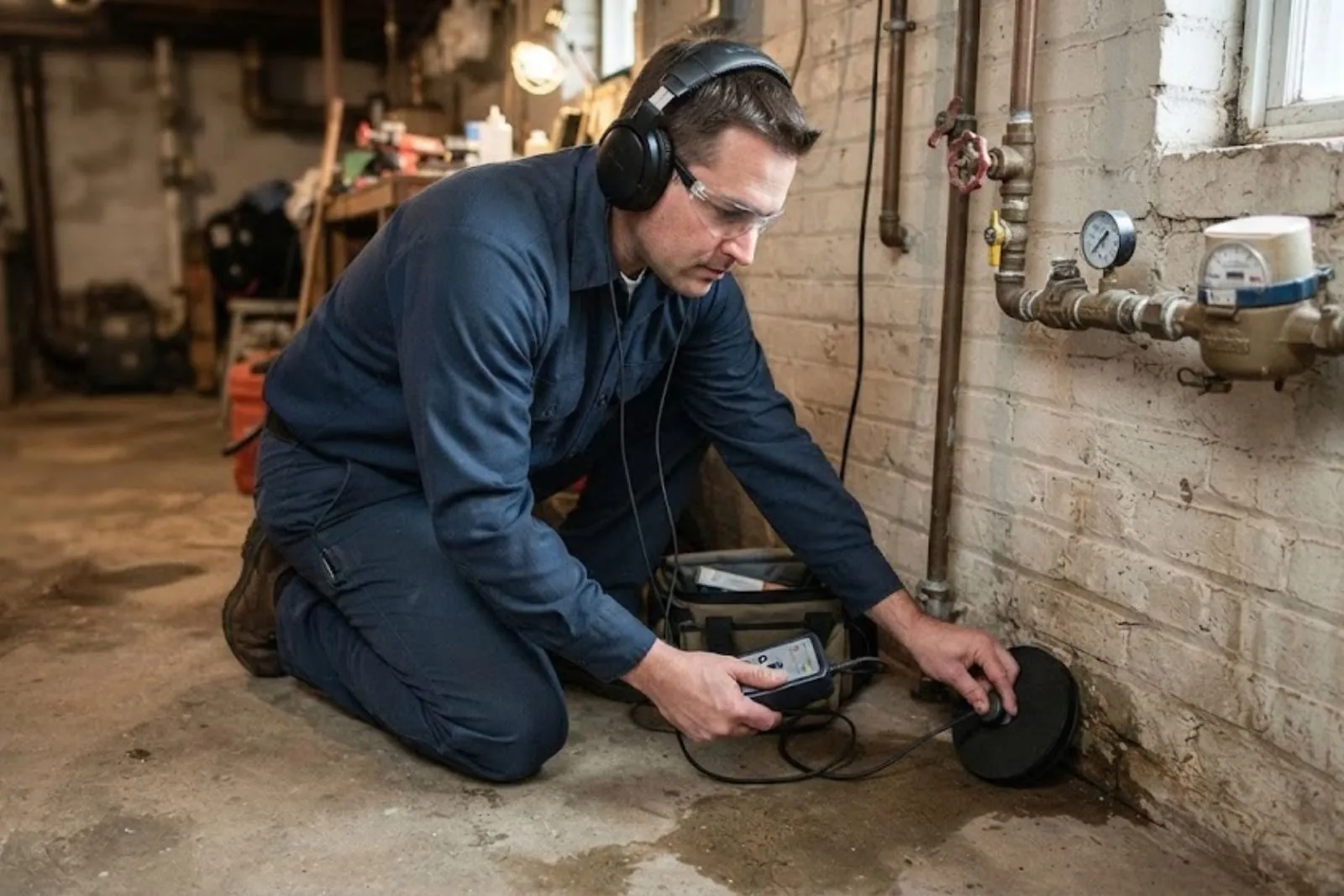
If you hear water running with every tap off, see a meter dial spinning, or find a warm patch on the floor, treat it as urgent. Our 24/7 line is open for hidden leaks in Simsbury, CT. While you wait, shut the main valve, keep people away from any wet outlets or panels, and write down your meter reading so we can compare it later.
Leak detection is the work of locating a water loss without tearing the house apart. A leak detection plumber confirms that water is escaping, narrows it to a pipe run, then pinpoints the spot using sound, heat, gas or pressure. Same-day appointments are available when the schedule allows.
Most leaks are small, slow and quiet, which is why they run for months. The goal is a hole the size of a dinner plate in the right place instead of a trench through the kitchen.
Hidden leak emergency: what to do right now
Do these four things right now
Active hidden leaks can soak insulation and subfloor in a single night. Cut the supply before you start hunting.
- Close the main shutoff valve, usually where the line enters the basement or utility room, and open one low faucet to relieve pressure.
- Stay out of rooms with wet floors if outlets, power strips or a panel are nearby, and switch off the breaker only from a dry spot.
- Photograph the meter face and any stains, damp drywall or warm floor areas with a date and time.
- Call the 24/7 line and tell us what you hear, where it is damp and whether the pressure has dropped.
Three water suppliers, so know whose meter you have
Public water in Simsbury is not run by the Town. According to the Town, Aquarion is the provider in most instances, while Connecticut Water and the Tariffville Water Commission also serve parts of town. Private wells fall under the Farmington Valley Health District instead.
That matters the moment a bill spikes. Your first call about a meter reading, a leak alert or a bill adjustment goes to your own utility, because only they can read or replace their meter and tell you where their pipe ends. Look at the name on your bill or the lid on the meter box before you pick up the phone.
The Town does not publish a street-by-street map of who serves what. If your bill is unclear, ask the utility directly and keep the account number handy when you call us.
Reading your meter and your bill
The EPA says nine percent of homes have leaks that waste 50 gallons or more per day, and the average household's leaks can account for more than 9,300 gallons wasted every year. Fixing the easy ones can trim about 10 percent from a water bill. A family of four using more than 12,000 gallons in a cold month such as January or February may have a serious leak.
A sudden jump on one bill with no change in habits points to something that started recently, such as a failed toilet flapper or a pinhole in a line. A slow climb over several bills suggests corrosion or a buried leak that keeps growing. Seasonal swings from irrigation can mask both.
The two-hour meter test
Turn off every fixture, the ice maker, the dishwasher and the washer. Read the meter, wait two hours without using any water, then read it again. If the numbers moved at all, you probably have a leak.
Next, close the main valve and watch the meter. If it still moves, the leak sits between the meter and your valve, which often means the underground service line. If it stops, the leak is inside the house.
Rule out the toilet
Drop a few drops of food coloring in each tank and wait 10 minutes without flushing. Color in the bowl means a leaking flapper, and the EPA suggests replacing flappers at least every five years. Flush right afterward so the dye does not stain.
Where hidden leaks usually hide
The pattern of symptoms tells us where to start listening.
Under the slab or floor
Warm spots on the floor, a hot water line that runs constantly or a meter that moves with the house quiet. Slab and crawlspace leaks need listening gear before anyone cuts concrete.
Behind walls and ceilings
Stains that grow after a shower, bubbling paint or a musty smell. The wet spot is often several feet from the actual break.
Between the meter and the house
Soggy lawn, a patch of green grass in dry weather or a drop in pressure. This is the service line, and ownership of each section is a question for your utility.
Irrigation and outdoor lines
Zones that never fully dry, mushy turf near heads or a meter that spins after the system is off. Valves and underground fittings fail often.
Water moving with everything off?
The 24/7 line is open, and same-day visits are available when the schedule allows.
How we pinpoint a leak without wrecking the house
Different leaks call for different instruments, and we usually combine two or three.
| Method | What it finds | Limits |
|---|---|---|
| Acoustic listening | The hiss or drip of pressurized pipe, through floors, walls and soil | Plastic pipe and background noise can muffle the sound |
| Thermal imaging | Warm or cool patterns from hot water lines and wet materials | Shows a wet area, not always the exact break |
| Pressure testing | Whether an isolated line holds pressure, and which zone loses it | Confirms a leak exists, then needs another tool to locate it |
| Tracer gas | Small leaks in buried or enclosed lines, by sniffing escaped gas | Needs the line isolated and filled |
| Inspection camera | Drain leaks and damage inside accessible pipes | Only works where the lens can travel |
Fixing it once it is found
Detection is only half the job. Once the spot is clear, there are two honest routes.
Spot repair
- A small access opening at the exact break, then a repair or fitting swap.
- Makes sense for one failed joint, valve or short section.
- Lower disruption, but other weak spots may remain in the same run.
- Drywall patching is separate and normally handled by a finish trade.
Reroute or replace the run
- A new line is run around the damaged section, often overhead or through walls.
- Makes sense when a pipe keeps leaking in different places.
- Larger job, but avoids repeated surprises under the slab.
- If the whole system is failing, a full repipe may be the cleaner answer.
Paperwork your utility or insurer may ask for
A written record can help when you ask for a bill review or file a claim. Ask your own utility and insurer what they accept, since policies and procedures differ.
- Dated meter photos from before and after the shutoff test.
- A written description of where the leak was found and what was done to repair it.
- The date the repair was completed, so the utility can compare billing periods.
- Photos of damaged materials before cleanup begins.
- Your policy details, since a pipe that bursts and floods floors is commonly covered under a standard policy while ground seepage usually is not. Confirm with your carrier.
How a leak visit runs
Triage by phone
We ask about the meter, stains, pressure and any recent work, then tell you what to shut off while we head over.
Isolate and test
We confirm the leak, then separate the service line, hot side, cold side and drains.
Pinpoint
Listening gear, thermal imaging or gas narrows the spot before any cutting.
Price, then repair
You get a clear price before work starts. Then we repair, or give you the findings in writing if the problem is the utility's side.
What drives the cost of finding a leak
We do not publish prices because every leak is different. These are the things that move the number.
Insurers differ on hidden or gradual leaks and on the cost of finding them, so check your policy before assuming coverage. Ask us for your real number, and we will explain what the quote includes before work starts.
Where leak detection stops
We find and fix plumbing leaks. We do not repair roofs, window flashing or foundation walls, and we do not do mold remediation or water-damage drying. Roof and window leaks belong with a roofer or envelope contractor.
A wet basement after heavy rain may be groundwater, not a pipe, and can point to waterproofing work or a failed sump pump. If the leak turns out to be on the utility's side of the meter, they decide who repairs it.
A sagging drain line or a wet spot over the sewer lateral might need camera work, and sewer line repair is a separate job. Tank leaks at the water heater can mimic hidden pipe leaks, so check the tank base too. Neighbors in Windsor can reach the same 24/7 line.
Frequently Asked Questions
Yes. The 24/7 line takes hidden leak calls overnight and on weekends, and same-day visits are available when the schedule allows. Shut off the main valve while you wait and keep clear of wet electrical areas.
Turn off all water, read the meter, wait two hours and read it again. Any movement suggests a leak. A bill that jumps with no change in habits, a warm floor spot or the sound of running water in a quiet house also point that way.
That decision belongs to your water utility. Aquarion, Connecticut Water and the Tariffville Water Commission each set their own process, so call the one on your bill. A written report with the repair date and meter photos gives them something concrete to review.
Often, yes. Acoustic listening, thermal imaging and pressure tests narrow the spot to a small area, so any opening is small and in the right place. Some leaks still need an access hole to confirm the exact break.
It can be. A worn flapper can leak silently for thousands of gallons per year, and the EPA suggests replacing flappers at least every five years. The food coloring test takes 10 minutes and costs almost nothing.
Yes, for plumbing inside the home and on your side of the line. We explain the repair options and the price before work starts. If the break is on the utility's side, we give you the findings so you can call them.