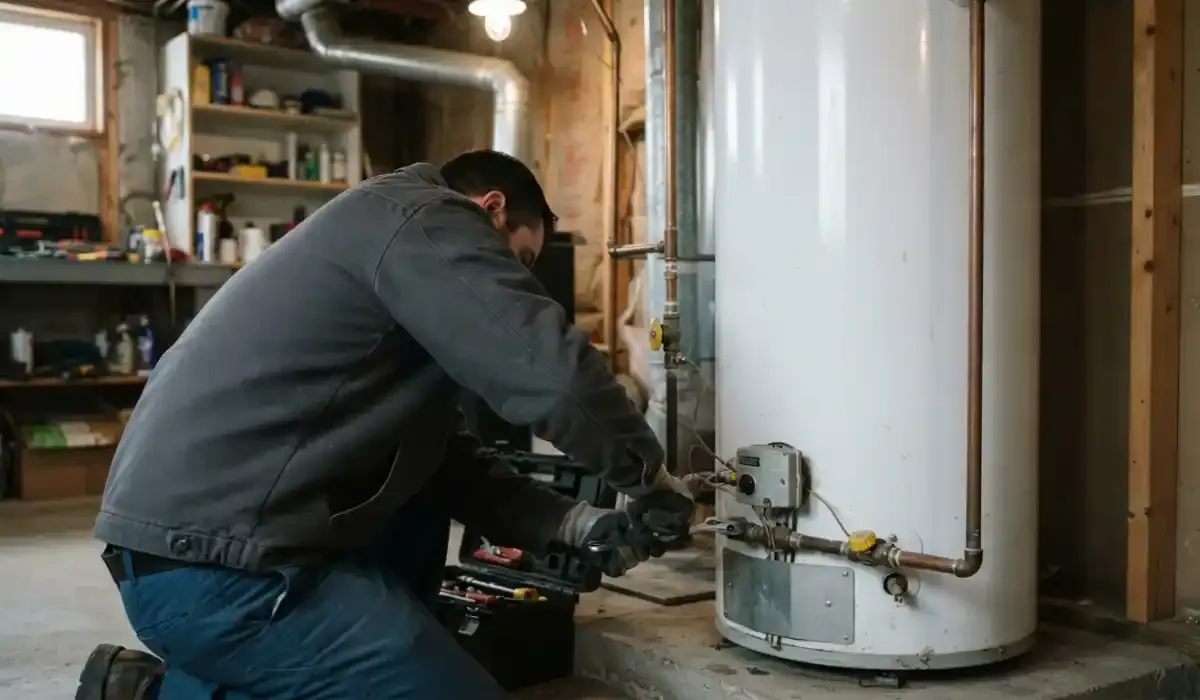
If your water heater is leaking, stone cold or tripping a breaker in Simsbury, CT, treat it as an emergency. The 24/7 line is open nights, weekends and holidays. While you wait, close the cold water valve on the pipe above the tank, switch off the breaker or turn the gas control to off, and keep children and pets away from wet floors near the unit.
Water heater repair means finding which part stopped the tank or heat pump unit from heating, then replacing that part or telling you straight that the tank itself has failed. Thermostats, heating elements, thermocouples, igniters and relief valves are all repairable. A steel shell that has rusted through is not.
Same-day visits are available when the schedule allows, and after-hours calls reach the same line as daytime ones.
Leaking water heater: shut it down safely
Do these in order while you wait
A thin trickle from the discharge pipe beside the temperature and pressure (T and P) relief valve is a different problem from a puddle under the tank. The first means pressure or temperature is running high. The second usually means the steel shell has failed, and every hour adds to the damage.
- Close the cold supply valve on the pipe entering the top of the tank. Turn the handle until it stops.
- For an electric heater, switch off its breaker in the panel. If the floor around the panel is wet, stay out and call us.
- For a gas heater, turn the gas control dial to off. If you smell gas at any point, skip every other step.
- Move boxes and stored items off the floor, then mop or wet-vacuum to slow the spread.
Gas smell near the heater: leave first
Leave the building and call Connecticut Natural Gas at 866-924-5325 or 911 before anyone calls a plumber. Do not flip switches, use a lighter or restart the heater. The state gas safety guidance also says never to turn gas back on after a safety shutoff, and to stay out until the gas company says the building is safe.
Leaking tank right now?
Close the cold supply, kill the power or gas, then call the 24/7 line. Same-day visits when available.
No hot water, odd noises and error codes
Most heater faults fall into a handful of patterns, and each points to a different part.
Cold or lukewarm, electric
A failed upper or lower heating element, a bad thermostat or a tripped high-limit reset is the usual cause. A multimeter shows which in a few minutes. When the tank is sound, this is normally a one-visit repair.
Pilot out, gas
A sooty thermocouple or flame sensor stops the burner from staying lit. Cleaning or swapping it is routine. Repeated outages point to a draft or venting fault that needs a closer look.
Breaker trips again
A breaker that trips the moment you reset it suggests a grounded element or damaged wiring. Stop resetting it, because repeated resets can overheat the circuit.
Short showers
A broken dip tube lets cold water slip straight to the hot outlet, and a scaled-up tank holds less real hot water than its label says. Both feel like the heater is running out early.
Rumbling or popping
Water trapped under a layer of sediment boils and thumps. A flush may quiet it, but a thick crust also tells you the tank is aging.
Blinking codes
Electronic gas controls and heat pump units flash codes for sensor, ignition or airflow faults. Photograph the code before you cycle the power, because it narrows the search.
What Simsbury's well water does inside a tank
Aquarion's 2025 Simsbury Regional water quality report lists hardness averaging 10 grains per gallon, with readings from 4 to 16. The same report says the supply comes from eight wells in town and that wells 7 and 8 are treated to reduce hardness. Hardness is not a regulated contaminant, so it never shows up as a violation. It shows up in your tank.
Dissolved minerals drop out as scale when water is heated. The crust coats electric elements or sits between a gas burner and the water, which wastes energy and makes the tank rumble. DOE suggests drawing off a quart from the drain valve every 3 months, and EPA WaterSense recommends a full flush once a year plus a yearly check of the T and P valve.
Ask for a flush and an anode rod inspection at any repair visit. The anode is a sacrificial rod that corrodes so the steel does not, and manufacturers recommend checking it periodically. Not every Simsbury address is on Aquarion, since the Town also names Connecticut Water and the Tariffville Water Commission, and some homes use private wells. Ask your own supplier, or test your tap, before assuming the 10 grain figure fits your street.
Gas, electric and hybrid heat pump heaters: how repair differs
DOE describes heat pump water heaters as moving heat from the surrounding air into the tank, and says most are hybrids with a backup electric element. That design changes what a technician checks.
| Heater type | Common faults | What repair involves |
|---|---|---|
| Gas tank | Pilot or igniter, thermocouple, gas control valve, blocked flue | Burner and draft checks. Back-drafting can put carbon monoxide in the house, so venting gets inspected every time. |
| Electric tank | Heating elements, thermostats, high-limit reset, wiring | Meter testing with the power proven off before any cover comes away. |
| Hybrid heat pump | Clogged filter, condensate drain, fan, sensor codes, compressor | Airflow and clearance checks. It can sometimes run on its backup element while the heat pump side waits for a part. |
| Tankless | Scale, flame rod, error codes, venting | Descaling and sensor work, covered under tankless water heater service. |
How the fault gets found
A technician starts by listening and looking, then measures. Voltage and continuity readings at the elements and thermostats sort out electric faults. On gas units, the checks cover flame quality, the flame sensor, the igniter and the draft at the flue hood.
Water pressure matters too. EPA WaterSense says fixtures work best between 45 and 60 psi, and a gauge on a hose bibb with everything off shows where you stand. A relief valve that weeps every time the burner cycles can point to a missing or waterlogged expansion tank rather than a bad valve.
Repair the tank or replace it
DOE says most storage water heaters last 10 to 15 years. Age is the first question, and the condition of the shell is the second.
Repair is the better call when
- The tank is dry, and the fault is a thermostat, element, igniter, thermocouple or valve.
- The unit is well inside the 10 to 15 year range.
- Sediment is light and the anode has not been spent.
- The failure is a one-off rather than the third part this year.
Replacement is the better call when
- Water is weeping from the shell, the seams or the bottom.
- The tank is at or beyond the 10 to 15 year range and has already failed once.
- Hot water runs rusty or the drain valve brings out thick sediment.
- Parts and labor would approach the cost of a new unit. See same-day tank replacement.
How an emergency repair visit runs
Make it safe
The plumber confirms the water, power and gas are off, then deals with standing water around the unit.
Diagnose
Meter readings, a draft check and a look at the tank, valves and venting settle whether this is a part or a failed shell.
Hear the price
You get a clear price for the repair and, if relevant, for replacement before any work begins.
Repair and test
The part is swapped, the heater is refilled and fired, and temperature and relief valve are checked before the plumber leaves.
What shapes the cost of a repair
We do not publish prices, because a thermostat swap and a gas control valve replacement are very different jobs. You hear the number before work starts.
Insurance treats these differently. The Insurance Information Institute says a standard policy generally covers accidental discharge of water from a plumbing system but not damage from lack of maintenance. A worn-out tank is rarely covered, while the resulting water damage sometimes is, so ask your insurer before you decide.
What repair cannot fix
A tank that leaks from the shell cannot be patched, and a repair that only delays the failure is not a bargain. Water on the floor does not always come from the heater, either. A supply connection or a slow hidden drip may be the source, and leak detection can trace it.
If a pipe near the heater has split, that is a job for burst pipe repair. Corroded supply lines throughout an older house are a repiping question, not a heater one.
We also dispatch to homes in Avon, Bloomfield and Canton, and the same checks apply there.
Frequently Asked Questions
Yes. The 24/7 line takes water heater calls overnight, on weekends and on holidays, and same-day visits are offered when the schedule allows. The dispatcher will ask about leaks, gas smell and water on the floor so the right visit is booked. A gas smell is the exception, because that call goes to Connecticut Natural Gas or 911 before a plumber.
Close the cold supply valve to stop new water entering the tank, then cut the energy source. An electric element left powered in a drained tank can burn out in minutes. For gas, turn the control to off unless you smell gas, in which case leave the building.
A dirty or weak thermocouple or flame sensor is the most common reason, followed by a draft that blows the flame around. Relighting it again and again hides the cause. If the flame gets weaker each time, have the burner and flue checked, because poor venting is also a carbon monoxide risk.
Not necessarily. Rumbling means sediment is trapping water against the bottom, which fits Simsbury's mineral content. A flush often calms it. If the drain valve brings out heavy chunks or rusty water, the tank is closer to the end.
Often yes, because many faults are filters, drains, fans or sensors. The unit needs room and airflow, and compressor problems can tip the decision toward replacement. Check the error code and the filter before you call.
Yes. Aquarion's report shows hardness from 4 to 16 grains per gallon, and scale builds wherever the water is heated. DOE suggests drawing off a quart every 3 months, and EPA WaterSense recommends a full yearly flush. Follow the manufacturer's instructions for your model.