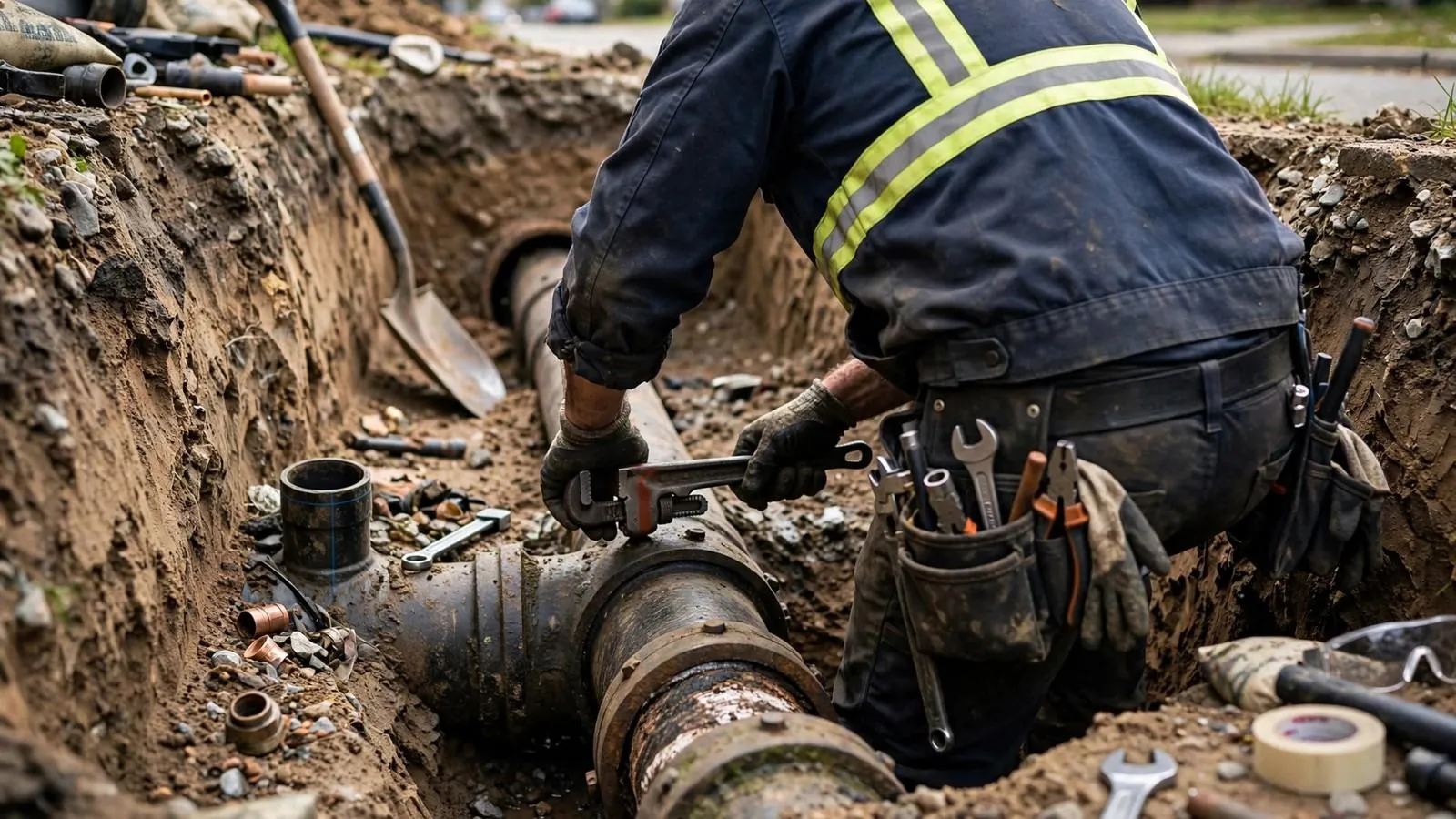
If sewage is backing into the house and a cleaning has not held, call the 24/7 line and stop using water. Keep toilets, showers and the washer off, stay out of wet areas near outlets, and leave the cleanout capped until a plumber is there. A line that fails repeatedly is often a damaged line, not a stubborn clog.
Emergency sewer line repair in Simsbury, CT covers the pipe between your house and the town sewer or your septic tank. The damage may be a crack, a root entry, a joint that has shifted or a low spot where waste settles. Fixing it means opening, relining or replacing that section, and the right choice depends on what the camera shows.
Every repair starts with a picture of the pipe, and we explain it before talking about solutions.
Sewage backing up again after a cleaning: what to do
Stop the damage first
A repeat backup in a line that was just cleaned is a strong sign the pipe itself has a problem.
- Stop all water use and keep everyone away from the backed-up area.
- Do not run drain chemicals. They sit in the water and complicate any repair.
- Turn off power to a flooded room only if you can do it from dry ground.
- Call the 24/7 line and mention that the drain was cleared recently, which helps us bring the camera.
Who owns the pipe, and who may repair it
In Simsbury, the town says the pipes inside a building and the laterals running to the main sewer are the property owner's responsibility, and lateral repairs must be done by a licensed plumber. State law points the same way, since the plumbing statute counts lateral sanitary lines from buildings to the mains as plumbing work, and the state licenses limited sewer contractors under the P-7 class.
In practice that means checking a contractor before you hire. The state eLicense lookup shows whether a plumber's license is active, and an excavation firm without one should not be touching the lateral. If sewage shows in the street or yard, report it to the Water Pollution Control Facility at 860-658-3258, because that may be a public main problem and changes who pays.
Cracked, rooted and bellied lines
Cracked or broken pipe
Ground movement, heavy loads or an old repair can split the pipe or pull a joint apart. Water leaks out, soil washes in and the line can slowly settle.
Rooted line
Roots enter at joints and cracks, then grow into a mat that traps paper. Cleaning clears the roots, but the opening stays, so the repair is sealing or replacing that section.
Bellied line
A belly is a low spot where water pools and solids settle. It clogs repeatedly, shows as standing water on camera, and usually needs the section lifted and re-sloped.
Collapsed section
A crushed or fully collapsed pipe stops flow completely. Jetting can make it worse, so a camera look comes first and replacement is the likely path.
Spot repair, lining or full replacement
The right fix follows the camera findings, and none of these is always best.
| Option | Best when | Trade-off |
|---|---|---|
| Spot repair (dig and replace a short section) | One break, one belly or one bad joint | Digs at the repair point only, but the rest of the old pipe remains |
| Pipe lining (cured in place) | Cracks and root entries in a pipe that is still round | Little digging, but it cannot fix a collapse or a belly |
| Pipe bursting | A long run of failing pipe with room at both ends | Replaces the whole run with few trenches, needs entry pits |
| Open trench replacement | Collapsed, bellied or badly offset pipe | The most disruptive to yards and drives, and the most certain fix |
Sewer line failing?
Call the 24/7 line. We book same-day visits when a crew is available.
Trenchless or open trench
The EPA describes trenchless rehabilitation, including pipe bursting, sliplining and cured-in-place pipe, as using the existing pipe as a host so less digging is needed. The same EPA research notes there is little quantitative evaluation of how some of these linings perform over long periods.
Trenchless
- Less disturbance to lawns, patios and driveways.
- Fits pipes that are still round with cracks or roots.
- Does not correct slope or a collapsed section.
- Needs a clean pipe first, so cleaning and camera work come before it.
Open trench
- Allows re-sloping a belly and replacing damaged sections fully.
- Gives the plumber clear sight of the pipe and bedding.
- Tears up landscaping and hard surfaces along the line.
- Needs underground utilities located before any digging.
Cast iron sewer pipe: how it fails and what to do
Cast iron was a common drain material for many years, and it can last a long time, but it does not last forever. It rusts from the inside, building rough scale that narrows the pipe, and the top of a horizontal run can corrode away. Joints and couplings can also leak or separate over time.
On camera, failing cast iron looks like a thick, flaking, rust-colored wall, sometimes with a gap at a joint or a section that has dropped. A short bad section can be cut out and replaced with modern pipe using proper couplings. When the scale runs along most of the line, patching one spot just moves the problem, and replacing the run is the more honest answer.
We will show you the footage and say which side of that line your pipe is on. Jetting cast iron can strip loose scale and expose weak walls, so the camera comes first.
Digging safely: call 811 before excavation
Connecticut law requires anyone excavating with power equipment to notify Call Before You Dig, by calling 811 or visiting CBYD.com, at least two full business days before digging. A homeowner doing the digging follows the same rule, and a contractor must make the call when it is hired. The service is free and the utilities mark their lines.
Sewer repairs often cross gas, water and electric lines, so this step matters. If your repair needs a trench, ask the Simsbury building department whether a permit applies before work begins.
How a sewer repair visit runs
Stabilize the backup
We clear the line enough to restore service so the camera can go in.
Explain the options
You see the footage and get a clear price for repair, lining and replacement before work starts.
Repair and verify
We complete the repair, run water through and camera the line again.
What drives the cost of a sewer repair
We do not publish prices because the range from a short spot repair to a full replacement is wide. You get a clear price before work starts.
The Insurance Information Institute says sewer backups are not covered by a typical homeowners policy or flood insurance, so check for an endorsement before you assume otherwise. Ask us for your real number when you call.
Limits of a sewer repair
A repair fixes the damaged pipe, not a blocked town main or a tank that needs pumping. We will say so when the town or a septic pumper is the right call. For routine buildup, sewer line cleaning may be enough, and neighbors over the line can find the Bloomfield crew at plumber Bloomfield CT. Trouble with the water supply pipes belongs under leak detection instead.
Frequently Asked Questions
Yes. The 24/7 line is open at night and on weekends, and we dispatch after-hours when a crew is available. We stabilize the backup first, then camera the line to see what failed.
The town's guidance says the owner is responsible for pipes inside the building and the laterals to the main. Sewage in the street or yard may be a public main issue, so call the Water Pollution Control Facility at 860-658-3258.
The camera decides. A round pipe with cracks or roots may suit lining, while a collapse, belly or offset joint usually needs the section replaced.
Not always. It saves restoration work, but it needs a pipe in good shape to line, and a belly or collapse still needs digging.
Not necessarily. Many cast iron lines still work. Heavy flaking scale, cracks at joints or dropped sections are the signs that point to repair or replacement.
Yes for any excavation with power equipment. The contractor makes the call when hired, and the notice must go in at least two full business days before digging.
Ask the Simsbury building department whether a permit applies to your job. Do not assume it does or does not.
- Town of Simsbury: if you have a plumbing blockage
- Connecticut General Statutes chapter 393 (plumbing and piping)
- CT DCP plumbing licenses and scope of work
- EPA pipe bursting fact sheet
- PURA: Call Before You Dig, homeowners
- Insurance Information Institute: which disasters are covered by homeowners insurance
- 2022 Connecticut State Building Code (2021 IPC plumbing edition), CT DAS Office of State Building Inspector