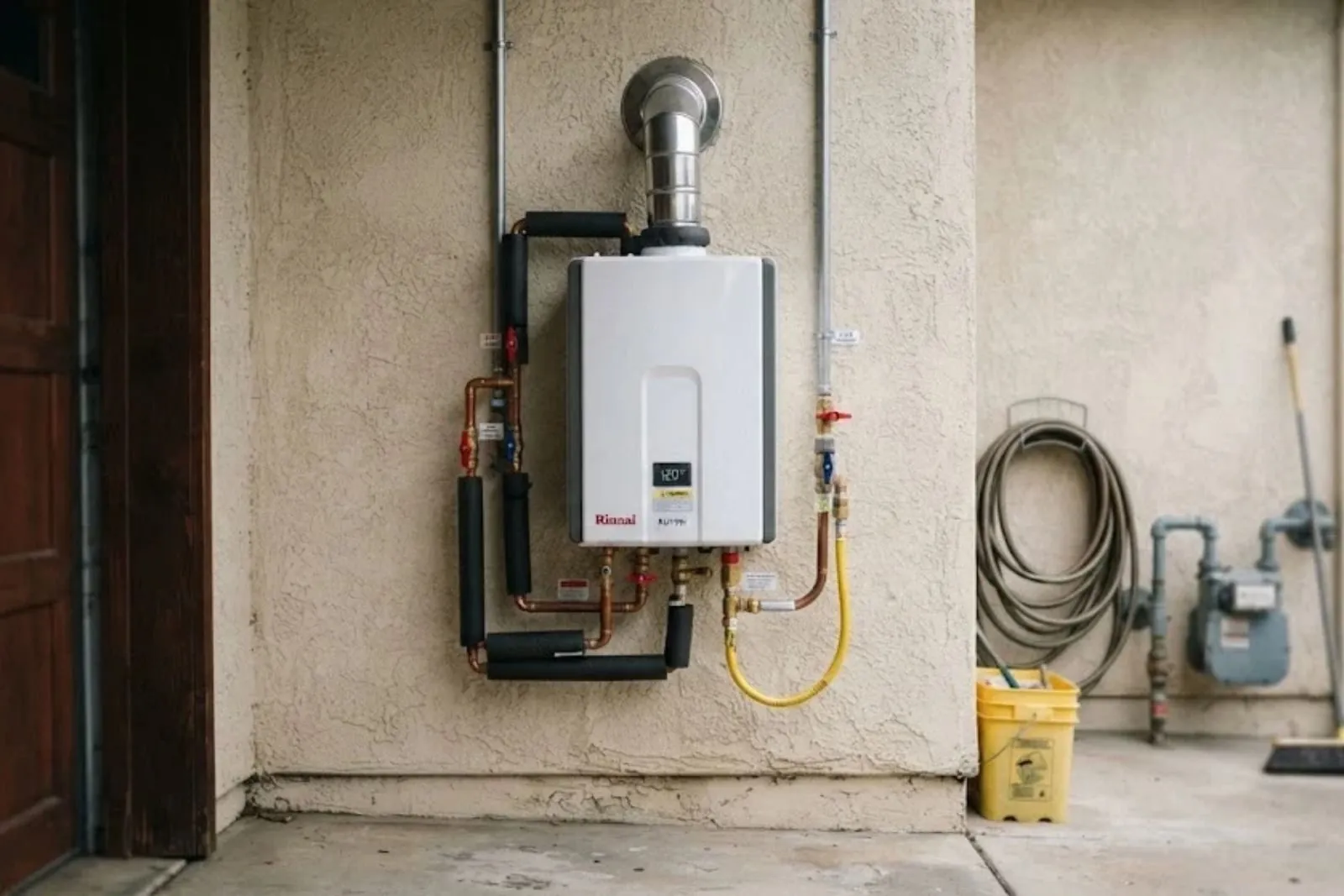
A tankless water heater in Simsbury, CT heats water on demand. When you open a tap, a flow sensor fires the burner or elements, and the water passes through a heat exchanger and leaves hot. There is no stored tank to run out or to rust through, which is why DOE says tankless units can last more than 20 years.
That long life depends on care. Simsbury's well-fed water carries dissolved minerals, and tankless heat exchangers have narrow passages that scale can choke. We install, descale, diagnose and, when it makes sense, replace tankless units, and we tell you plainly when an older one is not worth another repair.
Why Simsbury's water makes descaling a habit
Aquarion's 2025 Simsbury Regional water quality report gives an average hardness of 10 grains per gallon, with a range of 4 to 16, from eight local wells. The report notes that hardness is not regulated by EPA or the state health department, so nobody will flag it for you. It will appear instead as scale on the heat exchanger, reduced flow and eventually a fault code.
That makes yearly descaling a sensible routine for gas and electric tankless units on Aquarion water. Your own address may differ, since the Town also lists Connecticut Water and the Tariffville Water Commission, and some houses draw from private wells. Ask your supplier, or have your tap water tested, and set your descaling interval from what you learn plus the maker's manual.
Annual flush and descaling: what actually happens
A proper descale takes the unit offline for a short period, and the steps below are typical.
Isolate the unit
Power and gas are shut off, and the service valves on the hot and cold lines are closed so the heater can be flushed without draining the house.
Circulate descaler
A small pump moves food-safe descaling solution through the heat exchanger from one service port to the other, dissolving mineral buildup.
Rinse and clean
The unit is flushed with clean water and the inlet filter screen is cleared of grit.
Check and restart
Gas pressure, flame, vent and condensate drain are checked, and you see the exhaust and temperature readings.
Error codes and what they usually point to
Codes differ by brand, so photograph yours and look it up in the manual. The patterns below are common across makers.
| What you notice | Likely cause | Typical response |
|---|---|---|
| Ignition failure code | Low gas supply, dirty flame rod or weak igniter | Check gas pressure, clean or replace the flame sensor. |
| Overheat or temperature code | Scale restricting flow through the heat exchanger | Descale and verify flow. |
| Hot water fades at low flow | Clogged inlet screen or fixture aerators | Clean the screen and the faucet aerators. |
| Vent or exhaust code | Blocked, damaged or long vent, plugged condensate drain | Inspect the vent run and clear the drain. |
| Hot, cold, hot in a shower | Cold water trapped in lines between bursts | Consider a recirculation setup or adjust usage. |
Tankless unit throwing codes?
Photograph the display, then call the 24/7 line. Same-day appointments when available.
Repair or replace an older tankless unit
A tankless heater is built to outlast a tank, so many are worth fixing. The deciding facts are the heat exchanger and parts supply.
Repair when
- The unit is well under 20 years old.
- The fault is an igniter, flame sensor, fan or sensor, or scale that a descale can clear.
- The heat exchanger is dry and has not been damaged by freezing.
- Parts for your model are still available.
Replace when
- The heat exchanger leaks or has cracked.
- Descaling does not clear repeated overheat or flow codes.
- Parts are discontinued or the unit is around the 20-year mark DOE cites.
- You need more capacity. Compare with a fresh replacement before sinking money into repairs.
Gas line and vent sizing before you install
A gas tankless heater burns much more fuel per minute than a tank, even though it fires only on demand. The existing gas line may not deliver enough, because pipe size depends on the run length, the fittings and every other appliance on that line. Resizing the gas piping is licensed plumbing work, and the gas service in town is Connecticut Natural Gas according to the state utility regulator.
Vent materials depend on the model. Condensing units use plastic pipe and need a condensate drain, while non-condensing units use stainless vent. The maker sets maximum lengths and elbow counts, so the termination point on your wall matters. If you smell gas at any time, leave the house and call Connecticut Natural Gas at 866-924-5325 or 911 before calling us.
Recirculation and cold winter incoming water
A tankless heater raises water temperature by a fixed amount at a given flow. In winter the incoming water is colder, so the same unit delivers less flow at the same set temperature. Ask the installer to size the heater for your coldest months, not summer, and tell them how many showers run together. DOE notes that homes with simultaneous hot water use may need two or more units.
Recirculation adds a return line or a crossover valve so hot water waits near the fixtures. It shortens the wait and avoids the cold slug between bursts. The trade-off is added pumping and a more complex install, so ask whether the model you want supports it.
Who tankless suits, and who is better off with a tank
These numbers come from DOE. Your own use will differ. For a planned change, see water heater installation.
| Factor | Storage tank | Tankless |
|---|---|---|
| Typical life | 10 to 15 years | More than 20 years |
| Efficiency (gas) | Baseline | 24% to 34% better at 41 gallons a day or less, 8% to 14% better at about 86 |
| Space | Needs a floor footprint | Wall mount, smaller |
| Peak demand | Limited by tank size | Limited by flow rate, may need two units |
| Upkeep | Flush and anode checks | Yearly descaling and filter cleaning |
What shapes tankless pricing
A descale and a gas line upgrade are very different jobs, so we do not publish prices. You get a clear number before work begins.
Insurance rarely pays for descaling or normal wear. A sudden leak that damages a finished room may be covered by a homeowner policy, so ask your insurer, and see the Insurance Information Institute note on maintenance exclusions.
Limits and when to call for urgent help
We cannot repair a unit whose parts the maker no longer sells, and we cannot make an undersized gas line deliver more gas. If your tankless heater is leaking or has stopped heating tonight, the 24/7 line is open, and water heater repair covers the urgent side. If the leak turns out to be in the walls, leak detection can find it.
We serve homes in Avon, Bloomfield and Canton with the same service.
Frequently Asked Questions
Many makers call for a yearly descale, and Aquarion's 10 grains per gallon average makes it hard to justify skipping. Check your manual and your own water, since not every address is on the same supply.
Colder incoming water means the unit needs to add more heat, and at a given flow it may run out of capacity. Reducing flow, such as fewer taps at once, can help. A heater sized for summer may struggle in January.
Give the dispatcher the make, model and a photo of the nameplate when you call, and they will tell you whether we can work on it. Parts availability is the usual limit on older models.
DOE says gas on-demand units can be more efficient than tanks, with larger gains when daily hot water use is lower. Longer life is the second benefit. The upfront gas line and vent work can offset those gains, so ask for a full scope.
Not always. Descaling on a regular schedule may be enough on the hardness Aquarion reports. A softener is an option on harder water, and EPA recommends having a professional service the system once a year and checking the salt level.
It is the brief cold blast between two hot bursts. The heater stops, cold water remains in the pipes, then the burner relights. A recirculation loop or a buffer tank can reduce it.