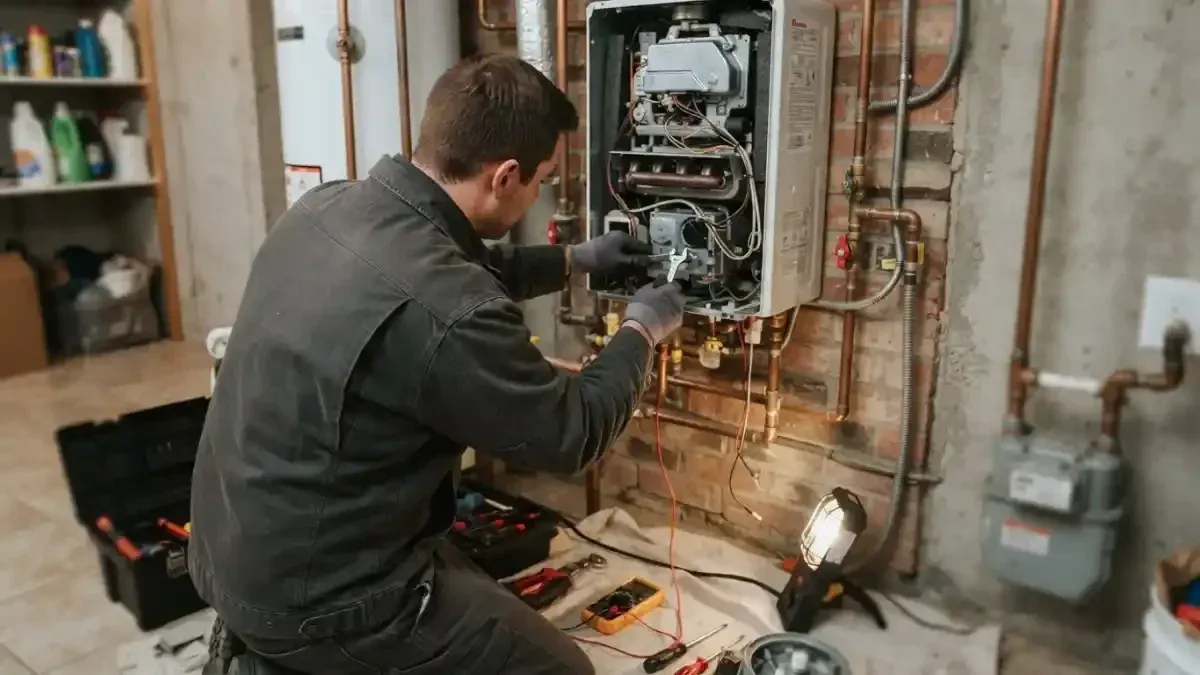
People search for Crown boiler repair when the house goes cold, but the faults behind a cold house are mostly shared by residential cast iron and similar boilers. This page covers those common problems, not the specifications of any one brand or model. When you call, read the nameplate on the boiler jacket and have the model and serial number ready, because parts, controls and the right fix depend on them.
Homes in Granby and Windsor run the same kinds of systems, so the advice carries over. If you smell gas, skip the troubleshooting and read the safety section.
Reading the aquastat and pressure gauge
Most hot-water boilers carry a gauge for water temperature and system pressure, plus an aquastat, the control that tells the burner when to fire and stop. Its high limit caps the water temperature, and a differential sets how far it can drop before the burner restarts. If someone changed those settings, the boiler can run too hot, too cool or too often.
Pressure matters as much. A cold, healthy hot-water system usually sits in the low teens psi, but the setting for your house comes from the installer or the manual, so do not trust a rule of thumb over the nameplate. A needle that creeps toward the rating printed on the relief valve means something is wrong, and a needle that drops toward zero means water is escaping or the expansion tank has failed.
No heat: a short checklist before you call
Each takes a minute and none involves opening the boiler.
- Confirm that the thermostat is set to heat, well above room temperature, and replace its batteries.
- Check the boiler's emergency switch, which looks like an ordinary light switch near the stairs or on the boiler, and the breaker in the panel.
- Look at the pressure gauge. Zero or near zero often keeps the burner from running.
- For an oil boiler, check the tank gauge. For a gas boiler, make sure the gas valve handle is parallel to the pipe.
- Press the red reset button on the burner control once. If the burner starts and stops again, do not keep pressing it.
Short cycling and noisy starts
A boiler that fires, shuts off, then fires again within minutes is short cycling. It wears parts and wastes fuel.
| What you notice | Common causes | What to check |
|---|---|---|
| Burner clicks on and off every few minutes | Oversized boiler, aquastat differential set too tight, dirty flame sensor | Note the temperature when it stops and starts, then write it down for the plumber. |
| Banging or knocking from the pipes | Air in the system, low water, scale on the heat exchanger | Look at the pressure gauge and check for cold radiators at the high points. |
| Heat in some rooms only | A zone valve stuck closed, a failing circulator, trapped air | Feel the pipes at each zone valve and circulator, and compare which are warm. |
Leaks, low pressure and the refill trap
A wet floor under the boiler can come from the relief valve discharge pipe, a weeping circulator flange, a pinhole in a section or the expansion tank connection. Wipe each joint dry and watch where the drip returns. A relief valve that opens regularly is warning of high pressure, often from a waterlogged expansion tank, and it should never be capped.
If pressure keeps falling, topping up by hand feels like a fix but the leak is still there, and fresh water brings in air and minerals. Hidden leaks in a slab or wall are a job for leak detection with pressure testing and listening gear before anyone opens walls.
Boiler down in the cold?
Our 24/7 line is open, and same-day appointments are available when the schedule allows.
Ignition faults and lockouts
When a boiler tries to start and then locks out, the cause is usually in the ignition chain. On gas, that means a dirty flame sensor, a worn igniter or a failing gas valve. On oil, it means a clogged nozzle or filter, a weak transformer or a dirty cad cell, the eye that proves the flame is there.
Repeated resets are the wrong response, because an oil burner that keeps trying can flood the combustion chamber and the next light-off can be loud. One reset is fine, and after that it is time for a boiler repair visit.
Circulators, zone valves and bleeding radiators
The circulator is the pump that pushes hot water through the loops. It fails by humming without turning, running loud or leaking at the flange. Zone valves, the motorized valves on each loop, fail by sticking closed, which leaves one floor cold while the rest heats.
If you have a hot-water system with radiators or baseboards and a cold spot at the top, trapped air is likely. Turn the thermostat down, wait for the pipes to cool, and open the small bleed screw with a key while holding a cup. Close it the moment water spits, then check the gauge, since bleeding can drop the pressure. Steam systems work differently and use vents, not bleed screws, so do not open anything on a steam radiator.
Annual service and what it should cover
The Department of Energy lists boiler life at 15 to 30 years and says periodic maintenance extends it. A yearly visit before heating season is the practical form of that advice.
- Clean the burner and heat exchange surfaces and check the flame sensor or cad cell.
- Test combustion and inspect the flue for blockage or leaks.
- Test the relief valve, low-water cutoff and aquastat settings, and check the expansion tank, circulator and zone valves.
- Keep radiators and baseboards clear of furniture and curtains so heat can move.
Gas smell and carbon monoxide: safety first
If you smell gas
Leave the building and call Connecticut Natural Gas at 866-924-5325 or 911 from outside or a neighbor's home. Do not touch light switches or the doorbell, use a phone near the odor or light a flame, and do not return until the gas company says it is safe.
- A boiler with a blocked, disconnected or leaking flue can release carbon monoxide, which has no color and almost no odor.
- Headache, dizziness and nausea that ease when you leave the house are warning signs, and a working CO alarm on each floor is the best early warning.
What Simsbury homeowners should know about heating season
Connecticut heating seasons are long. The National Weather Service's 1991 to 2020 normal for the average January low at Hartford's Bradley airport is 18.8 degrees Fahrenheit, so a Simsbury boiler works hard all winter. Book the annual service before the first cold snap, when boiler calls are busiest.
For gas-fired boilers, the state's utility regulator lists Connecticut Natural Gas as the gas company for Simsbury, and the gas company handles the meter and the line up to your house. The piping and the boiler downstream are your property and need a licensed professional. Not every home is on gas, so check your fuel before you call.
A prolonged winter outage is its own boiler risk. After Storm Alfred on October 29, 2011, some Connecticut customers waited nearly two weeks for power. A boiler needs electricity for the burner and circulator, so a cold house risks frozen pipes. Know where your main water shutoff is.
Frequently Asked Questions
The nameplate gives the manufacturer, model, serial number, input rating and often the fuel and maximum working pressure. With those, a plumber can look up the right controls, igniter or sensor and the proper settings. It also shows the boiler's age, which matters when you weigh repair against replacement.
The usual causes are a leak, a relief valve that is opening, an expansion tank that has lost its air charge or a stuck automatic fill valve.
Each points to a different repair, so write down the readings and call.
On a hot-water system, yes, with the boiler cooled, a key and a cup. Close the screw as soon as water shows and recheck the pressure.
If the system is steam, if you are not sure, or if the bleed screw is stuck or seized, leave it for a plumber.
Connecticut's Office of the State Building Inspector runs a safety code for boilers and hot water heaters, and its page says certain boilers need registration and inspection. The page does not say whether one to four family homes are covered, so we will not guess.
Ask your installer or the Simsbury building department what applies to your boiler.
- PURA: who to call for natural gas emergencies
- PURA: what to do if you smell natural gas
- US DOE home heating fact sheet
- EPA: what is carbon monoxide
- NWS Boston/Norton climate report for Hartford (Bradley)
- CT Storm Response and Recovery Assessment Group final report (2012)
- CT DAS Safety Code for Boilers and Hot Water Heaters
- 2022 Connecticut State Building Code (2021 IPC plumbing edition), CT DAS Office of State Building Inspector