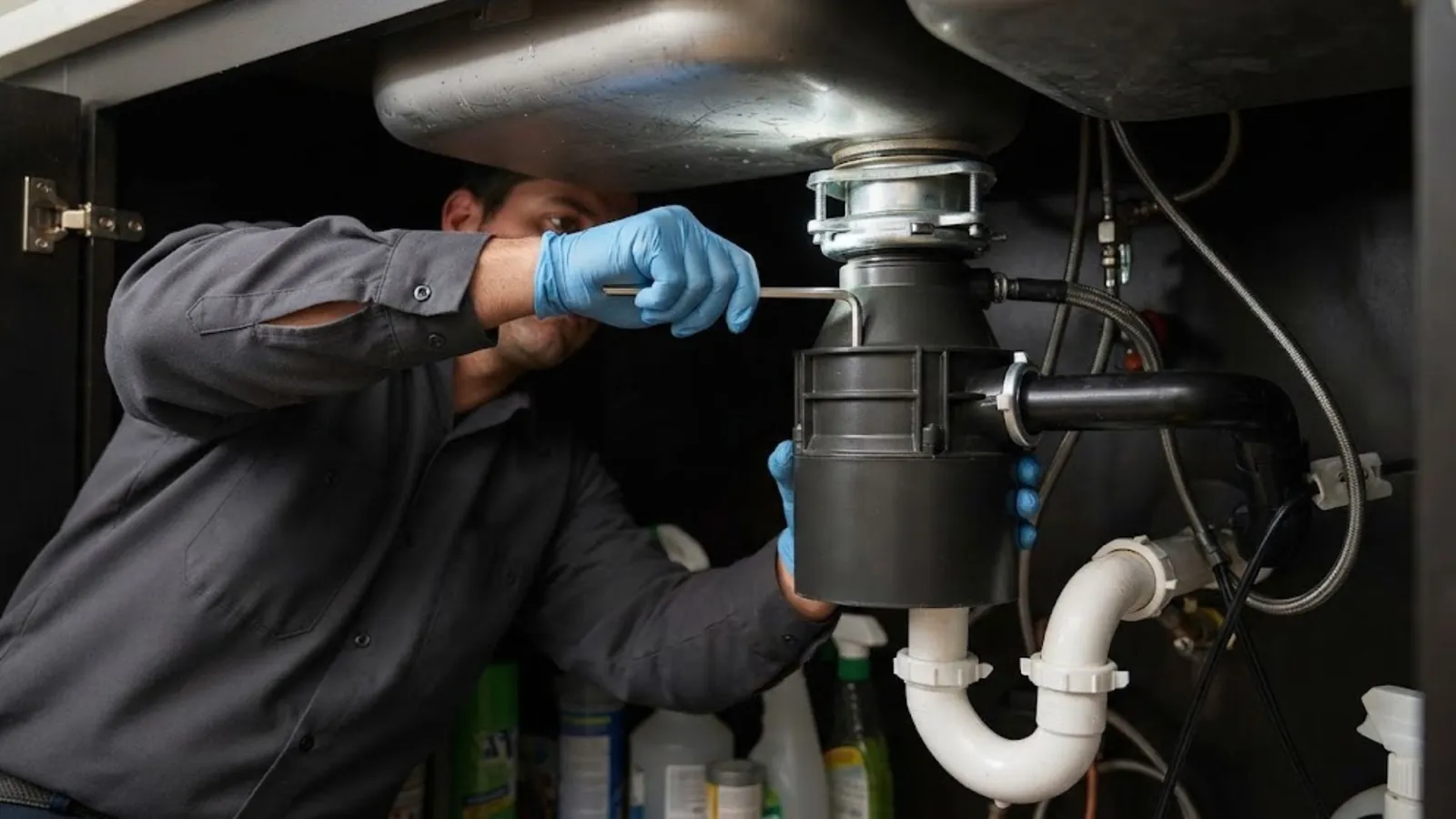
A garbage disposal fails in one of three ways. It hums and does nothing, it stays completely silent, or it leaks water into the cabinet below. Each symptom points to a different part, and most fixes take less than half an hour with a hex key, a screwdriver and a flashlight.
This guide starts with the safety rule that matters more than any repair step, then works through each symptom, the dishwasher connection that trips up installers, and the point where replacement beats repair. It also covers what to keep out of the unit in a Simsbury kitchen, where some homes sit on septic.
Power off first and keep your hand out of the chamber
Do this before touching anything
The grinding plate looks harmless when it is stopped, and it is not. A disposal can start the moment power returns.
- Switch off the wall switch, then unplug the unit or turn off its breaker at the panel.
- Never put a hand or fingers inside the chamber, even with the unit off. Use tongs, pliers or a wooden spoon handle to pull out objects.
- Look into the opening with a flashlight to find the object before you try anything else.
- Keep the unit unplugged until the repair is finished and the cabinet is dry.
Humming versus silent: two different faults
The sound the unit makes tells you whether the motor is working and the blades are stuck, or the motor is not getting power at all.
It hums but does not spin
- The motor has power, but something jams the flywheel.
- A spoon, bone, fruit pit or bottle cap is the usual culprit.
- Use the hex key in the bottom of the unit to free it.
- Do not keep flipping the switch, because a stalled motor overheats.
It is completely silent
- No hum usually means no power, a tripped overload or a loose cord.
- Press the red reset button on the bottom of the unit.
- Check the outlet under the sink and the circuit breaker.
- A dead motor is possible if all of those test fine.
Hex key and reset button: the two fixes that solve most calls
Most disposals ship with a small L-shaped Allen wrench that fits a socket at the center of the bottom. If you lost it, a quarter-inch hex key from a hardware store fits many models.
Cut the power
Unplug the unit and confirm the wall switch is off.
Work the hex key
Insert the key into the bottom socket and turn it back and forth until it spins a full circle.
Clear the chamber
Remove the jammed item from above with tongs, never fingers.
Press reset
Wait a few minutes for the motor to cool, then push the red button on the bottom, plug in, and test with cold water running.
Where a disposal leaks and what each leak means
Dry the cabinet, put a sheet of newspaper under the unit, and run water. The place the paper gets wet tells you the cause.
| Where it leaks | Likely cause | Fix |
|---|---|---|
| Top, around the sink flange | Failed plumber's putty or gasket | Remove the unit, reseal the flange, remount |
| Middle, at the housing seam | Cracked housing or failed internal seal | Replace the unit |
| Side, at the drain elbow | Loose gasket or flange bolts | Tighten bolts, replace the gasket |
| Dishwasher hose | Loose clamp at the inlet nipple | Reseat and tighten the hose clamp |
| Bottom, under the motor | Worn shaft seal | Replace the unit |
Dishwasher connection and the knockout plug
The dishwasher drain hose connects to a small side inlet on the disposal. New units ship with a plastic plug sealing that inlet, and it must be knocked out with a screwdriver and a hammer before the dishwasher is connected.
If the plug stays in, the dishwasher cannot drain, and water backs up into the dishwasher or onto the cabinet floor. If it drops inside the unit, fish it out before the unit runs, because it can jam the blades. Once the plug is gone, the hose clamps onto the inlet and loops high before it meets the drain to keep sink water from running back.
Replacing a disposal that was working, or moving one after cabinet work, is a routine garbage disposal repair job for a plumber. Reconnecting the dishwasher is the part homeowners most often miss.
Disposal leaking into the cabinet?
Switch it off and call the 24/7 line. Same-day appointments when available.
Jams, clogs and slow sinks above the unit
A sink that fills with gray water after the unit runs can have a clogged trap or drain line below the disposal rather than a bad unit. Fibrous scraps such as celery, corn husks and onion skin pack into a dense mat, and grease coats the pipe wall behind it.
Flush with cold water while the unit runs so grease stays solid enough to pass. For a persistent slow sink, a plumber's drain cleaning with a cable past the trap clears the line without removing the disposal. A grinder cannot cure a blocked kitchen line, and extra grinding makes it worse.
Repair or replace the disposal
A disposal is a mechanical part with a motor, bearings and seals, and not all of them can be fixed.
Repair makes sense when
- The fault is a jam, a reset, a loose wire or a bad drain gasket.
- The unit is a few years old and otherwise quiet.
- The leak is at the flange or hose, outside the motor housing.
Replace when
- Water leaks from the housing seam or under the motor.
- The unit hums and the flywheel will not free up after the hex key.
- It trips the reset again and again, or the motor smells burned.
What Simsbury homeowners should know about septic and kitchen grease
Not all properties in Simsbury are connected to the public sewer. Septic systems are serviced by private companies and fall under the Farmington Valley Health District, so confirm what your home has before you lean on a disposal for daily food waste.
The EPA says a disposal can change how often a septic tank needs pumping, because food waste builds up as scum and sludge and can push solids into the drainfield. It also says never to flush cooking grease or oil, coffee grounds, paper towels or non-flushable wipes. On septic, scrape plates into the trash or compost, and use the disposal for small scraps.
Sewered homes still need grease discipline. The Town's blockage guidance lists slow draining, gurgling and backups in tubs, toilets or floor drains as signs of a blockage. Wipe pans with a paper towel before washing, put cooled grease in a sealed container for the trash, and call the Simsbury Water Pollution Control Facility if you see sewage outside.
Frequently Asked Questions
The motor is getting power but something jams the flywheel. Cut the power, turn the hex key in the bottom socket until it spins freely, remove the item with tongs, then press reset.
If the hum continues after that, the motor may have failed, and replacement is likely.
It is an overload reset. When the motor overheats or jams, it trips to protect the windings. Wait a few minutes, press it firmly, and try again.
It can, but the EPA says disposals change pumping frequency, so a tank may need pumping more often. Keep fats, oils, grease and coffee grounds out of it.
Ask your septic contractor how often the tank should be inspected, and call the Farmington Valley Health District with questions about your system.
Odors usually come from film in the splash guard, the underside of the flange, or a dry P-trap. Scrub the rubber baffle with a brush and dish soap, then run cold water for a minute.
If a smell comes from a floor drain or several fixtures, check with a plumber.