A bathroom sink that empties slowly but never fully stops is a puzzle, because plunging and a quick chemical treatment often do nothing. That is because the cause is not always a plug of hair. It can be the stopper mechanism, a slick film inside the trap, a blocked vent, or a partial blockage that lets water squeak through.
This guide walks through the likely causes in the order that saves the most time, starting with the pop-up stopper and ending with the main drain. It also explains what it means in Simsbury when more than one fixture slows at the same time.
The pop-up stopper and linkage come first
Most bathroom sinks have a pop-up stopper that lifts and lowers with a lever behind the faucet. A pivot rod runs from that lever into the drain body under the sink, and a clevis strap with several holes sets how far the stopper rises. If the strap is in the wrong hole or the nut is loose, the stopper lifts only part of the way and throttles the flow.
Test it by pulling the stopper straight up and out. On many sinks it lifts out, and on others you must loosen the pivot nut under the sink first. If the sink drains faster with the stopper out, the linkage needs adjusting, or hair has wrapped around the stopper's shaft and needs to be cleaned off.
Hair and soap scum biofilm in the tailpiece and trap
Soap, toothpaste and skin oils coat the inside of the tailpiece and P-trap with a slimy film, and hair catches in it like a net. The film narrows the pipe a little at a time, so the sink gets slower over weeks instead of failing overnight.
Clean it by placing a bucket under the trap, loosening the two slip nuts by hand or with channel-lock pliers, and pulling the curved trap and tailpiece free. Scrape the film with a bottle brush, rinse, and reassemble with the washers seated flat. A sink that runs fast again with the trap off and slow again with it on has told you exactly where the problem sits.
How to diagnose a slow sink in order
Work down this list, and stop when the sink drains normally.
| What you see | Likely cause | Test |
|---|---|---|
| Slow only with the stopper in | Linkage or stopper blocking flow | Pull the stopper out and refill |
| Gurgling as water leaves | Vent partly blocked or partial blockage | Run the tub and sink together |
| Fast with trap removed, slow with it on | Biofilm or hair in the trap | Clean the trap and tailpiece |
| Slow at the sink, tub and shower | Branch line or main drain buildup | Fill each fixture and release it |
| White crust around the drain opening | Mineral scale narrowing the opening | Look and feel under the stopper flange |
When the vent is the problem, not the drain
Every fixture drain connects to a vent pipe that runs up through the roof and lets air in behind the water. Without that air, a draining sink pulls against a vacuum, empties in a slow gulp, and gurgles as air sneaks in through the trap.
A bird nest, leaves or frost in the vent opening can cause this, and so can a vent that was cut or capped during a remodel. If the sink gurgles and runs slowly in the same event, and cleaning the trap changes nothing, suspect the vent. A plumber can test it from inside the house, and roof access is a reason not to try it yourself.
Sink slow after cleaning the trap?
Call the 24/7 line and a licensed plumber can trace it. Same-day appointments when available.
Partial blockages further down and scale at the drain opening
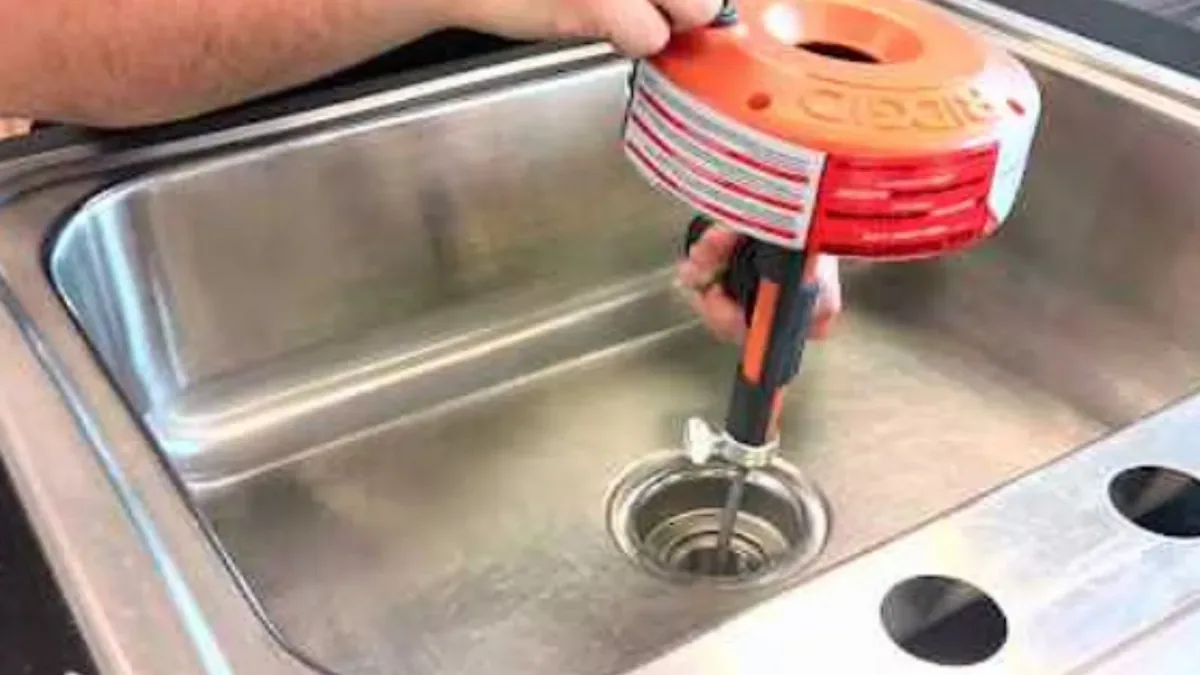
A partial blockage past the trap, such as a mat of hair at a pipe joint or a rough spot on a cast iron branch, lets water through slowly. A hand-crank snake pushed gently past the trap often clears it. If the snake meets resistance a few feet in, stop forcing it, because that may be a joint or a bend.
Mineral scale is the other stealth cause. Hard water leaves a crust around the stopper flange and inside the first inch of the drain. Soak the stopper and flange in white vinegar and scrub with a brush, and the opening opens back up. When a camera shows scale or buildup deeper in the line, drain cleaning with a cable or a jet is the practical fix.
When several fixtures slow down together: what to do
One slow sink versus a house-wide pattern
One slow sink points to that sink. Two or three slow fixtures point to the line they share.
- Slow sink and slow tub on the same branch suggest a partial blockage past where they join.
- A toilet that gurgles when the sink drains means the shared line is restricted.
- Slow drains at every fixture, a floor drain that bubbles, or sewage odor points to the main line.
- Water that backs up into the lowest fixture, such as a basement shower, is an emergency.
What Simsbury homeowners should know about sewer authority and slow drains
Not all properties in Simsbury are connected to the public sewer. The Town's Water Pollution Control Facility can tell you whether yours is in the sewer service area, and homes outside it run on septic systems that fall under the Farmington Valley Health District. The answer decides who you call when several drains slow at once.
The Town lists slow draining or gurgling, backups in tubs, toilets or floor drains, sewage odor, pooling water outdoors and all drains backing up at once as signs of a plumbing blockage. All drains backing up at once points to the main sewer line. The pipes inside the building and the lateral to the main are the owner's responsibility, and lateral repair needs a licensed plumber, so a sewer line cleaning visit is often the right first step.
If sewage shows outside or in the street, report it to the Water Pollution Control Facility, because it may be a public main problem. On septic, the EPA lists slow drains and gurgling among the warning signs, so do not wait if the lawn over the tank stays soggy or smells.
Frequently Asked Questions
The blockage may be past the trap, in the branch line or the main. Try a hand snake through the trap arm, and check whether the tub or toilet also acts slow.
If more than one fixture is affected, a plumber can use a camera to see the line, for example through a sewer inspection.
Yes. A blocked or missing vent leaves a vacuum behind the water, so the sink drains in a slow gulp and gurgles. If cleaning the trap does not help and the sink gurgles, ask a plumber to test the vent.
It can, through scale that builds on the stopper and the first inch of the drain. Aquarion's 2025 report lists average hardness of 10 grains per gallon for its Simsbury system, so some scale is normal. Vinegar soaks and a brush handle the opening itself.
It usually means the shared branch line has a partial blockage. If the toilet gurgles or a basement floor drain bubbles, suspect the main line.
In Simsbury, the owner is responsible for the lateral, so a licensed plumber should clear it and the Water Pollution Control Facility should hear about visible sewage outside.
After the stopper is checked and the trap cleaned, call if the sink is still slow or if more than one fixture is affected. Homeowners in Bloomfield and Windsor follow the same sequence, though sewer rules differ by town.
- Town of Simsbury, If you have a plumbing blockage
- Town of Simsbury, How do I find out if a property is connected to public sewer
- EPA resolving septic system malfunctions
- Aquarion 2025 Simsbury Regional water quality report
- 2022 Connecticut State Building Code (2021 IPC plumbing edition), CT DAS Office of State Building Inspector