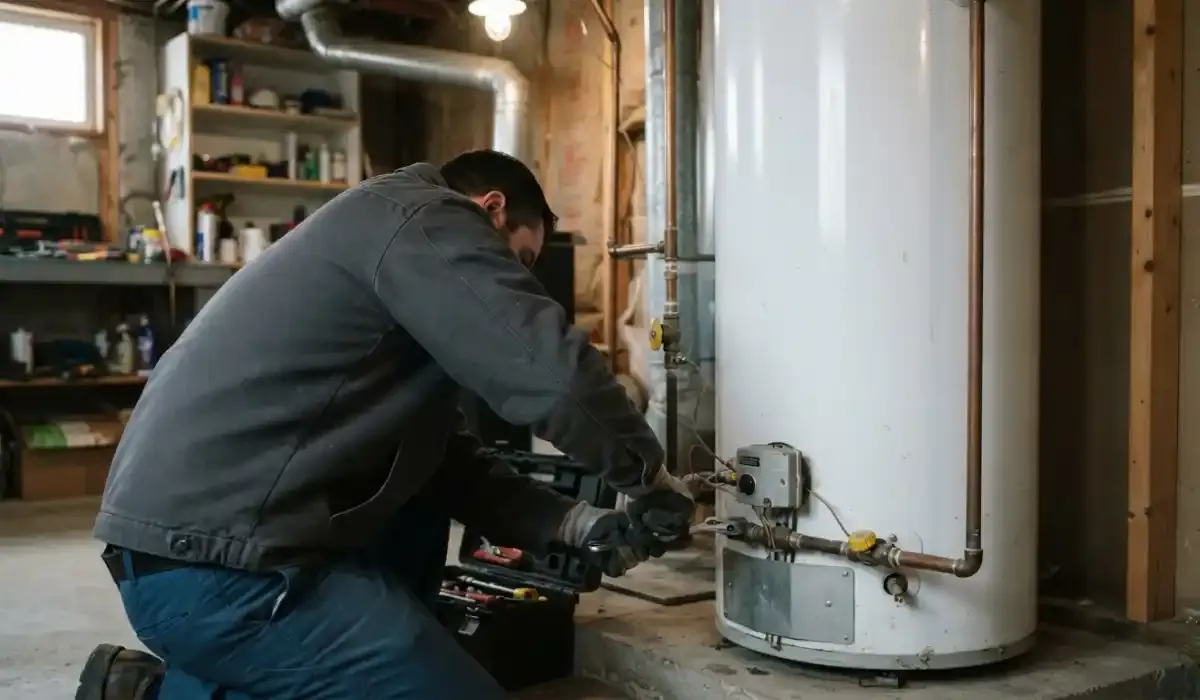
A dip tube is a plain plastic pipe inside your water heater, and when it fails it makes a healthy tank behave like a worn-out one. Showers that fade to lukewarm, hot water that runs out early and small white flecks clogging faucet aerators are the classic signs.
We do not publish prices, because the real number depends on the tank, the fittings and the age of the whole unit. The same checks apply to homes in Avon and Canton, though the water source and its hardness may differ from yours.
What the dip tube does inside the tank
Cold water enters a tank water heater through the inlet fitting on top of the tank. The dip tube hangs from that fitting and carries the incoming water all the way down to the bottom, where the gas burner or the lower electric element can heat it. Hot water collects at the top and leaves through the outlet fitting beside the inlet.
When the tube cracks, shortens or crumbles, cold water spills out near the top of the tank instead of the bottom. It mixes with the hot layer right where the outlet draws from. What reaches your shower is a blend, so the tank feels like it has lost half its capacity.
Lukewarm showers and plastic flecks: how a failed tube shows up
These are the signs that point to the tube rather than the burner or element.
- Hot water that turns lukewarm within a few minutes, even though the temperature setting has not changed.
- Shorter hot showers than the tank size would suggest, with no leak at the base.
- Small white, grey or cream plastic flecks in faucet aerators and showerhead screens.
- The same flecks in the fill screens of the washing machine or dishwasher, which then fill slowly.
- Bits that bend or squash between your fingers instead of crumbling like grit.
Is it the dip tube or something else?
Scale and rust flakes can also clog aerators, but they feel hard and gritty and break apart when pressed. Plastic is soft and flexible.
Lukewarm water has other causes too. A failed lower element, a bad thermostat, a dirty gas burner or a faucet cartridge that leaks cold into the hot side can all feel the same. A water heater repair visit sorts these out by testing the element or burner and measuring the outlet temperature, so expect a technician to confirm before parts are ordered.
How a dip tube gets replaced
The hard part is usually an old fitting that will not budge.
Shut down and drain
Power is switched off at the breaker or the gas control is set to off, the cold shutoff is closed and a hot tap is opened. Enough water is drained to bring the level below the inlet.
Disconnect the inlet
The cold supply line is disconnected and the inlet nipple is unscrewed with a pipe wrench or socket. After years of heat and minerals these threads can be seized.
Fit the new tube
The old tube is pulled out in pieces if needed, a new tube and nipple go in with thread sealant rated for drinking water, and the supply line is reconnected.
Refill, purge and test
The tank is refilled with a hot tap open until the air is out, power or gas is restored, and the connections are checked for drips. The outlet temperature is read once the tank has reheated.
Lukewarm water that will not improve?
Our 24/7 line is open, and same-day appointments are available when the schedule allows.
Anode rod and sediment checks while the tank is open
With the tank partly drained, this is the cheapest moment to look at the anode rod. The rod is a sacrificial bar, usually magnesium or aluminum, that corrodes instead of the steel tank. If it is worn down to the core wire, the tank steel is next in line, so a spent rod is a reason to replace it now or to question the tank's remaining life.
Sediment gets the same attention. Mineral grit settles on the tank bottom and often causes popping or rumbling. The US Department of Energy advises draining a quart from the tank every 3 months, and EPA WaterSense recommends a yearly flush, a yearly check of the temperature and pressure valve and a look for leaks and corrosion.
What moves the price of a dip tube job
We quote after seeing the tank. These are the things that make one job larger than another.
Access and layout
A tank in an open basement is quick to work on. A tank in a closet or attic, with the top fittings boxed in by pipes, takes longer.
Condition of the inlet fitting
A seized or corroded nipple can need extra time and parts, and it can leak when disturbed.
Add-ons done at the same visit
An anode rod swap, a flush, a new temperature and pressure valve or new connectors each add parts and labor.
Tank type and age
Gas, electric and power-vented tanks differ in setup. The bigger factor is age, because a tank near the end of its life may not be worth the spend.
Timing of the visit
A scheduled daytime visit usually costs less than an after-hours call, and same-day service depends on availability.
When the tank is too old to bother
The Department of Energy puts the usual life of a storage water heater at 10 to 15 years. A tank in its second decade that needs a tube, an anode rod and a new inlet nipple can run up repairs worth a large share of a new unit.
Lean toward replacing the tank if there is rust around the fittings, water at the base, rusty hot water or a history of repeated repairs. Lean toward repair when the tank is younger, the shell is clean and lukewarm water is the only complaint.
What Simsbury homeowners should know about water and your water heater
Aquarion's 2025 Simsbury Regional water quality report covers Simsbury, Granby and East Granby and lists a pH average of 7.5 and a hardness average of 10 grains per gallon, with a range of 4 to 16. It also says wells 7 and 8 are treated to reduce hardness. Hardness at that level leaves minerals that settle as sediment in a tank, so a yearly flush and a look at the anode rod are worth doing.
A range of 4 to 16 means your tank may see more or less scale than the average suggests. The report says nothing about anode rod wear, so inspect the rod instead of guessing.
Not every Simsbury home is on Aquarion. The Town says Aquarion is the provider in most cases, with Connecticut Water and the Tariffville Water Commission serving other parts. Connecticut Water's annual reports leave out hardness, so if that is your utility, ask it for an estimate or test your tap. Well owners should test the water before blaming the heater.
Frequently Asked Questions
Plastic flecks in aerators and a tank that feels hot at the top while the shower runs lukewarm point toward the tube. A dead lower element, a bad thermostat or a gas burner problem can look similar, so testing is the only way to be sure.
It is a realistic job for a handy owner when the tank is accessible and the nipple turns freely. Seized fittings, gas connections and the risk of a leak when the tank refills are where most do-it-yourself attempts stall.
Connecticut law has an exception for owners who do plumbing work on their own occupied single-family home, but the work must meet the State Building Code and is subject to inspection by the building official. Ask the Simsbury building department what that means for your job.
We cannot give a health ruling. The flecks are mainly a nuisance that clogs aerators and appliance fill valves, and they signal that the tube is breaking down.
If anyone in the home has a health concern, ask a doctor, and have the tube replaced promptly so the pieces stop entering the pipes.
Nothing in the Aquarion 2025 report says it does. With a hardness average of 10 grains per gallon and a range of 4 to 16, expect mineral sediment to build in the tank over the years, which is why a flush and an anode rod check matter.
Your own tap may differ if you are on another supplier or a private well, so test the water or ask your utility.
- Aquarion 2025 Simsbury Regional water quality report
- Town of Simsbury water supply FAQ
- US DOE Energy Saver Guide (water heater life and sediment advice)
- EPA WaterSense home maintenance
- Connecticut Water Avon system 2024 report
- 2022 Connecticut State Building Code (2021 IPC plumbing edition), CT DAS Office of State Building Inspector