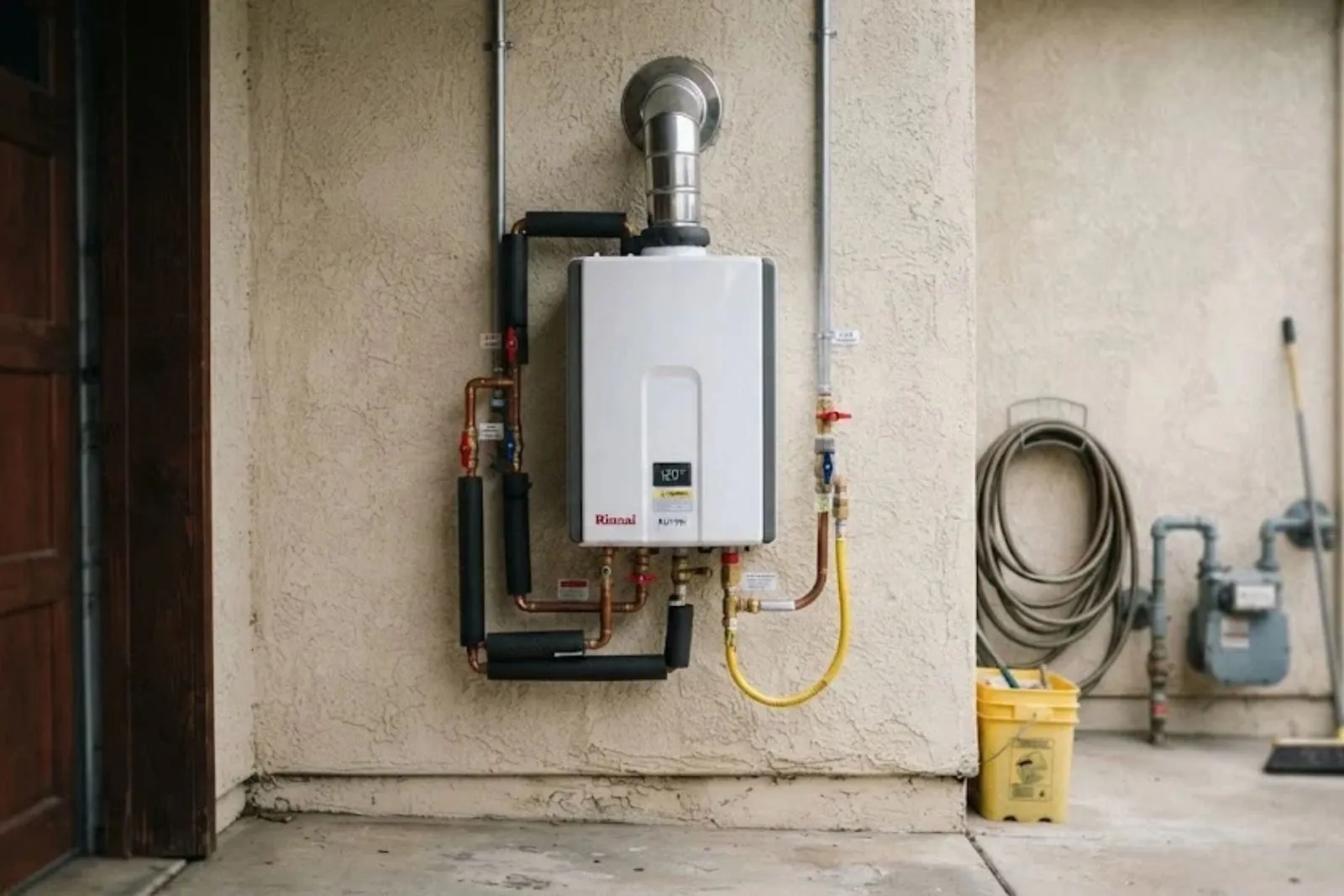
A tankless water heater, also called an on-demand heater, makes hot water only while a tap or appliance is calling for it. Cold water enters the unit, passes through a heat exchanger, and leaves hot. When you shut the tap, the burner or elements stop.
That design removes the standby loss of a big tank that keeps 40 gallons or more warm all day. It also changes what the house must supply, how the unit behaves in January and how it is maintained. The sections below cover each of those, and what Simsbury water adds to the picture.
How a heat exchanger makes hot water on demand
When you open a hot tap, a flow sensor inside the unit notices water moving and triggers the heat source. In a gas model, a fan starts, the burner lights and flame heats a metal heat exchanger with water running through narrow passages. In an electric model, heating elements do the same job without flame or a flue.
A control board watches the outgoing temperature and adjusts the burner or element power to hold your setpoint. This is why a tankless unit can hold steady temperature through a long shower, and why it needs electricity even when it burns gas. A tankless water heater is a heating appliance with sensors, not just a pipe with a flame.
Tank versus tankless at a glance
Neither type is better for every house. The trade-offs depend on how many people use hot water, and when.
Storage tank
- Keeps a reserve of hot water ready, so several taps can run at once until it runs out.
- Lower purchase price and simpler installation in most homes.
- DOE says most storage heaters last 10 to 15 years.
- Loses heat from the stored water all day, even when nobody is home.
- Can run out during back-to-back showers and then needs time to recover.
Tankless
- Heats water as it flows, so a long run of hot water does not drain a reserve.
- Higher price, and gas models often need larger gas pipe and special venting.
- DOE says tankless units can last more than 20 years.
- Limited by flow rate, so too many taps at once can bring the temperature down.
- Needs regular descaling, and does not work in a power outage unless backed up.
Gas or electric: what your house must supply
Gas tankless units can deliver higher flow, but they need a gas line big enough for the burner, a vent suited to the exhaust and usually a condensate drain. Many homes already on natural gas will need the gas pipe upsized, which is plumbing and piping work that Connecticut law reserves for licensed plumbers.
Electric tankless units need no vent, but the power they draw is large. They may need heavy-gauge wiring and extra breaker capacity, and a panel that is already full can become the deciding factor. Ask for a load calculation before you price either type.
Homeowners in Avon and Windsor face the same gas-versus-electric choice.
Flow rate is the ceiling
Every tankless unit has a maximum flow at a given temperature rise. Run a shower, a dishwasher and a washing machine at once and the unit may not keep up, so the water turns lukewarm. DOE notes that homes with simultaneous hot water use may need two or more units.
To size one, add up the flow of the fixtures you run together at the same moment, then check that against the unit's rating at your needed temperature rise. A family with two bathrooms in use every morning is a very different case from a couple that showers one at a time.
Tank failing now?
Same-day appointments are offered when available, and the 24/7 line stays open.
Why January changes what a tankless can deliver
A tankless heater raises the temperature of incoming water by a set amount, and the colder that water starts, the more heat it needs to add. In midwinter, the water entering a house is much colder than it is in August. The same unit that gave a full-pressure shower in summer may cut flow or fall short of the setpoint in January.
Good sizing uses the coldest inlet temperature you expect, not the average. If a quote does not mention winter, ask how the unit was sized for the coldest month.
Flushing a tankless unit step by step
Descaling clears mineral buildup from the heat exchanger. Follow the manufacturer's instructions for your model, and know that the exact solution and timing vary.
Shut off power and fuel
Turn off the unit's power and gas or water supply as the manual directs, and close the isolation valves.
Connect the pump and hoses
Hook a small pump and two hoses to the service ports on the isolation valves, with a bucket of descaling solution.
Circulate the solution
Run the solution through the heat exchanger for the time the manufacturer lists, then drain it.
Rinse and restore
Flush with clean water, clean the inlet filter screen, close the ports and return the unit to service.
Signs a tankless unit is a good fit for your home
- You want endless hot water for long showers and a steady run, not a reserve that empties.
- Your gas line, vent path and electrical panel can support the unit, or you accept the cost to upgrade them.
- You use hot water at predictable times, so peak demand is easy to size.
- You will schedule yearly flushing instead of ignoring the unit for a decade.
- You are weighing a first-time water heater installation or a move away from an aging tank.
What Simsbury homeowners should know about hard water and tankless units
Aquarion's 2025 Simsbury Regional report lists hardness averaging 10 grains per gallon, with a range from 4 to 16. It says the hardness comes from erosion of natural deposits and that neither EPA nor the state health department regulates it. Scale clings to the narrow water passages in a tankless heat exchanger, so a unit at the 16 end of that range will scale faster than one at the 4 end.
That spread is the reason not to copy your neighbor's flush schedule. Aquarion's report says two of its Simsbury wells are treated to reduce hardness, but the same report still shows readings up to 16. Test your own tap with a hardness kit, or ask your water utility, then schedule descaling on the manufacturer's interval, and sooner if the unit shows temperature swings or error codes.
Aquarion is the provider in most cases, but the Town says Connecticut Water and the Tariffville Water Commission also serve parts of Simsbury, and private wells fall under the Farmington Valley Health District. If you are not on Aquarion, do not assume these numbers apply. Hardness figures from the right source tell you whether a scale filter or softener is worth a look.
Frequently Asked Questions
Most manufacturers call for periodic descaling, and Simsbury water is not soft. Aquarion's 2025 report shows hardness averaging 10 grains per gallon. Follow the interval in your manual, and shorten it if the water is harder where you live.
It depends on the unit's maximum flow and how cold the incoming water is. Two modest showers may be fine on a larger gas unit in summer, then struggle in January. Ask for sizing at the coldest inlet temperature.
Not on its own. Gas models still need electricity for the fan, igniter and controls, and electric models draw large current. Storm Alfred in October 2011 left some Connecticut customers without power for nearly two weeks, so ask about a backup power plan if outages worry you.
Often yes, but well water changes the maintenance. Private wells in Simsbury fall under the Farmington Valley Health District, and state guidance has well owners test hardness, pH and iron regularly. Share those results before sizing a unit or planning descaling.
DOE says tankless units can last more than 20 years. Real life depends on water hardness, maintenance and how hard the unit works. A unit that is flushed on time will outlast one that never is.
- Aquarion 2025 Simsbury Regional water quality report
- Town of Simsbury water FAQ
- US DOE Energy Saver Guide 2022
- CT Storm Response and Recovery Assessment Group report
- CT DPH residential well testing fact sheet
- 2022 Connecticut State Building Code (2021 IPC plumbing edition), CT DAS Office of State Building Inspector