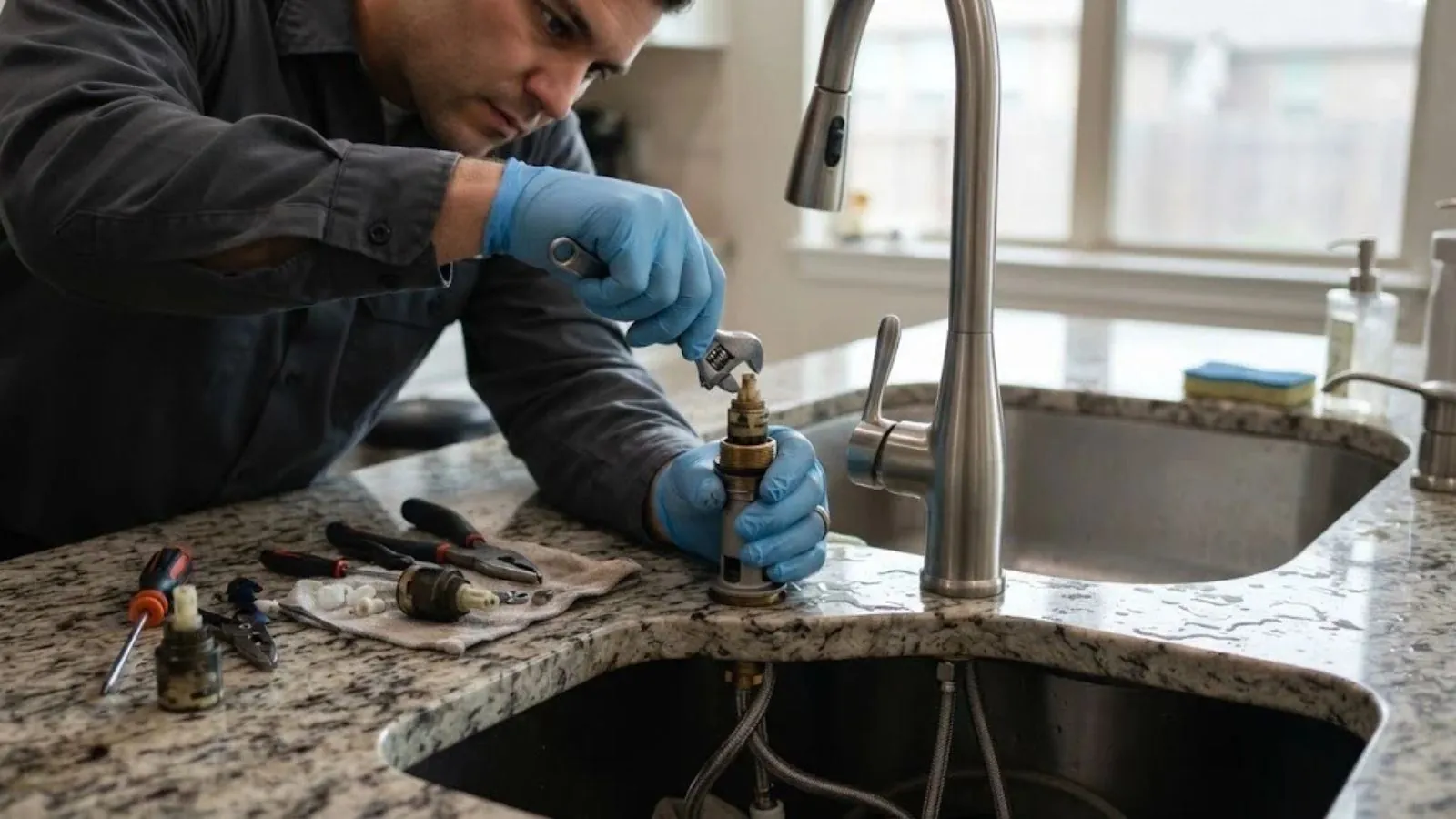
A faucet that drips once per second wastes more than 3,000 gallons per year, according to the EPA. In a Simsbury kitchen or bathroom that drip nearly always comes from one worn rubber or ceramic part, and the part usually comes out with a screwdriver and an adjustable wrench.
This guide walks through the four faucet designs found in most homes, how to tell which one you have before buying anything, the repair steps, and the signs that a new faucet will serve you better. It also covers who to ask when a leak shows up on the water bill, since Simsbury homes are not all served by the same utility.
Four faucet designs and what wears out in each
Every residential faucet controls flow with one of four mechanisms. The mechanism decides which part leaks and which repair kit fits.
Compression faucets
The old two-handle design. Turning the handle drives a stem down so a rubber seat washer presses on the valve seat. A drip from the spout means a hardened washer or pitted seat.
Cartridge faucets
Common in single-handle faucets. A cartridge slides or rotates in the body, sealed by O-rings. Water at the base of the spout points to worn O-rings, while a spout drip usually means a new cartridge.
Ball faucets
A single handle on a rounded cap, common in kitchens. A slotted ball rides on two spring-loaded rubber seats. Leaks show at the base and under the handle, and a kit of seats, springs and O-rings is the usual fix.
Ceramic disc faucets
A single lever on a wide cylinder with two polished ceramic discs. These last longest, so a drip more likely means worn rubber inlet seals or grit between the discs.
How to tell which type you have before you buy parts
Start with the handles. Two separate handles usually mean compression or a two-handle cartridge, and you can tell them apart by feel. A compression handle turns several full rotations from off to on, while a cartridge handle stops after a quarter or half turn.
A single lever is trickier. Pry off the cap or loosen the small hex set screw under the lever, and look inside. A rounded metal ball under an adjusting ring is a ball faucet, a wide cylinder with flat ceramic faces at the bottom is a disc, and a slim brass or plastic stem with a retaining clip is a cartridge.
Shut off the water and protect the sink first
Look under the sink for the two small handles on the supply lines. These are the angle stops, and a quarter turn clockwise closes each one. Open the faucet afterward to bleed off pressure and confirm the flow stopped.
If a stop will not turn, or it weeps around its stem, do not force it. Close the main shutoff and call for help, since a cracked stop under a cabinet turns a drip into a flood. Plug the drain with a rag first, because a set screw dropped down an open drain is gone for good.
Step-by-step repair that fits most faucets
The order below applies to all four designs. Only the part you replace in the middle changes.
- Close both angle stops, open the faucet, and plug the drain.
- Pry off the handle cap, remove the handle screw, and lift off the handle.
- Unscrew the bonnet nut or retaining ring with an adjustable wrench, wrapping the nut in a cloth so the finish does not scratch.
- Pull the stem, cartridge, ball or disc cylinder straight out, and note how the pieces sit.
- Replace the worn part, which is the seat washer on a compression faucet, the cartridge, the ball kit, or the inlet seals under a disc cylinder.
- Reassemble in reverse, coat new O-rings with plumber's silicone grease, and snug the nut without cranking it.
- Open the stops slowly, run the faucet for a minute to clear air, and check under the sink with a dry paper towel.
Water coming out from under the sink?
Close the angle stops and call the 24/7 line. Same-day appointments when available.
What the drip is telling you
Where the water shows up points to the part. Use this to decide what to order before you open anything.
| Where it leaks | Likely cause | Usual fix |
|---|---|---|
| Drips from the spout, two handles | Worn seat washer or damaged seat | New washer, resurface or replace the seat |
| Drips from the spout, single lever | Worn cartridge, ball seats or disc seals | Swap the cartridge or the seal kit |
| Pools around the base of the spout | Dry or cut O-rings on the body | Replace O-rings and grease them |
| Seeps under or around the handle | Loose retaining nut or worn stem O-ring | Tighten the nut, replace O-ring |
| Wet cabinet under the sink | Supply line, angle stop or faucet shank | Replace the line or stop, check the shank |
When a new faucet beats another repair
A professional faucet repair makes sense while the body is sound. These lists help you decide.
Repair it when
- The leak is from the spout or a handle and the body is clean inside.
- The faucet finish is intact and parts are still sold for your brand.
- You have not already replaced the same cartridge or seals in the past year.
Replace it when
- The body has pitting, cracks or green and white crust around the seat.
- The maker no longer sells a cartridge or kit for the model.
- The shank leaks under the sink, or the mounting nut spins freely.
What Simsbury homeowners should know about a dripping faucet and the water bill
The EPA says household leaks waste nearly 1 trillion gallons of water a year across the country. It adds that the average household's leaks can account for more than 9,300 gallons wasted every year, and that nine percent of homes have leaks that waste 50 gallons or more per day. Fixing easily corrected leaks, such as dripping faucets, can save about 10 percent on water bills.
To check whether the drip is the whole story, use the EPA meter test. Read the water meter, use no water for two hours, and read it again. If the meter changes at all, you probably have a leak somewhere, and the faucet may be only one of them.
The Town of Simsbury says it does not service public water. In most instances Aquarion Water Company is the provider, and Connecticut Water and the Tariffville Water Commission serve other parts of town. If a leak shows up on the bill, ask which utility reads your meter. Homes on private wells fall under the Farmington Valley Health District and have no utility meter to read.
Frequently Asked Questions
Usually yes, if the angle stops under the sink close fully and you can identify the faucet type. The tools are a screwdriver, hex keys and an adjustable wrench, plus the right kit.
Stop and call a plumber if a stop will not shut off, a stem is seized, or the leak is at the shank under the sink. Forcing those parts breaks them.
Water at the base of the spout points to O-rings. A drip from the spout when the faucet is off points to the cartridge, ball seats or disc seals inside.
If you replace O-rings and the spout still drips, the cartridge is the part to swap.
On a compression faucet the brass valve seat may be pitted, so the new washer cannot seal against it. A seat dresser or seat wrench fixes that. Mineral grit from the supply can also hold a washer off the seat.
If the seat is badly worn or the faucet is old, replacing the faucet is often the quicker fix.
Find the utility name on the bill first. The Town says public water is not serviced by the Town, and in most instances Aquarion is the provider, with Connecticut Water and the Tariffville Water Commission serving other areas.
Ask that utility how it reads your meter, then run the two-hour meter test. If the meter moves with everything off, a plumber can use leak detection to find the source.