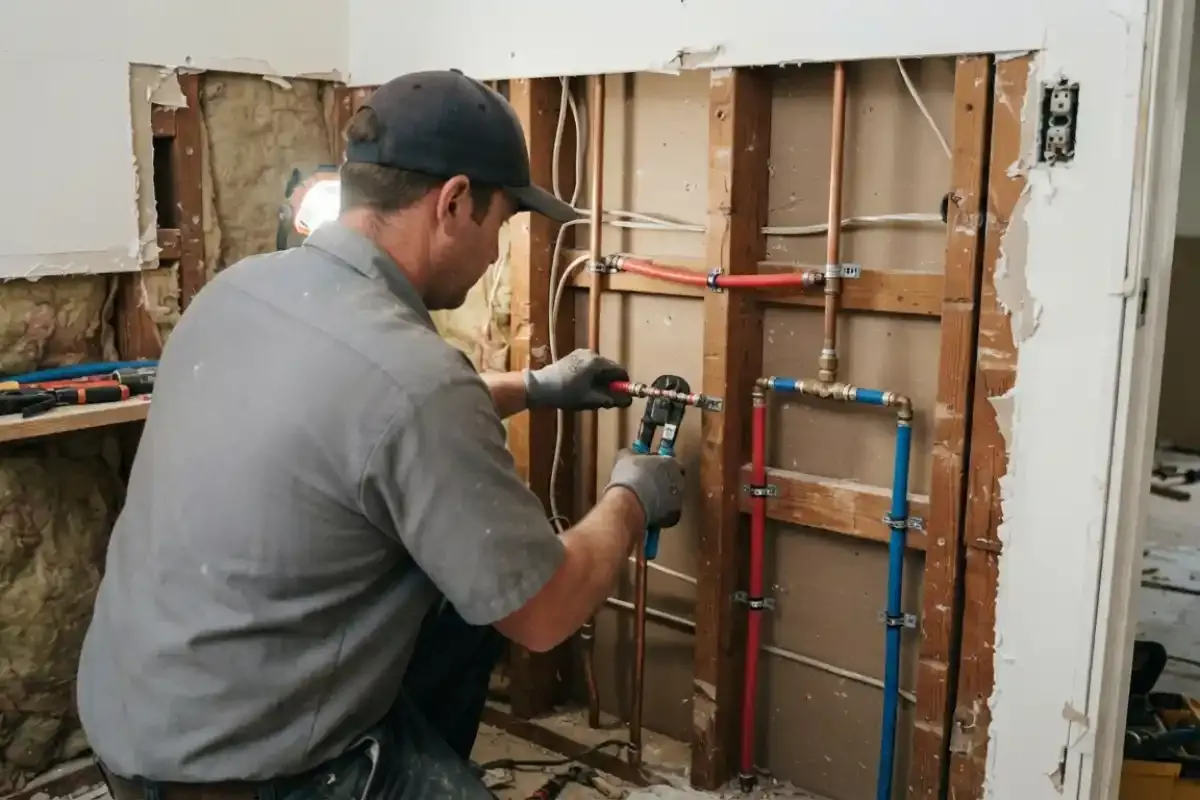
A repipe is the replacement of the water supply piping inside a house, the lines that run from where water enters the building to every tap, tub and appliance. It does not usually include the drain and sewer pipes, which carry waste away. Most repipes happen because the old supply pipes are leaking, corroding or restricting flow.
Repiping is a big decision, and homeowners in Bloomfield and Windsor weigh the same questions. We do not publish prices, because they depend on the size of the house, the material and how much wall has to be opened.
Whole-house or partial: what a repipe can cover
A whole-house repipe replaces the supply lines to every fixture, from the main shutoff to the water heater and out to each bathroom, kitchen and laundry. A partial repipe replaces one section, such as a bathroom branch or the lines in a basement ceiling. That is sensible when the problem is limited and the rest of the pipe is sound.
A leak in one section often means the rest is the same age and condition. That is why a repipe comes up after the second or third repair on the same line. The pattern, not a single leak, tells you the system is wearing out.
Pinholes, brown water and weak flow: signs you may need one
- Pinhole leaks in copper that keep reappearing in new places, with green crust, damp drywall or a ceiling stain.
- Brown, yellow or rusty water from the taps, especially after the house has sat unused for hours.
- Low pressure at several fixtures, not just one. EPA says fixtures work best between 45 and 60 psi, and much lower than 45 can signal a leak.
- Repeated repairs on the same line, or a plumber telling you the pipe is brittle, scaled inside or corroded at the joints.
- A water bill that rises with no change in use, or a meter that moves with all fixtures off.
Before you commit: confirm that it is the pipes
Low pressure and discolored water do not always mean failing pipes. A partly closed main valve, a clogged aerator or a failing pressure regulator can cut flow, and sediment from a water heater can discolor hot water only. A technician should test pressure with a gauge on a hose bib.
If you suspect a leak but cannot find it, leak detection with listening gear, thermal imaging or pressure tests pinpoints the spot, and it may show one repair is enough. EPA suggests a meter test, reading the meter before and after two hours with no water used.
Copper, PEX and CPVC compared
The right choice depends on your house, your water and your budget.
| Material | Strengths | Trade-offs | Often chosen when |
|---|---|---|---|
| Copper | Long track record, rigid, handles heat well | Needs soldered or press joints and skilled labor, and can develop pinholes in some water | You want traditional piping and have open access |
| PEX | Flexible, fewer joints, can be fished through walls | Must be protected from sunlight, and fittings and tools vary by system | Walls are finished and you want the least demolition |
| CPVC | Light, solvent-welded joints | Rigid, and the glued joints need careful work | Budget matters and runs are straightforward |
| Mixed or partial | Different materials for different runs | Needs correct transition fittings | Only part of the house is being replaced |
Pinholes or brown water?
Our 24/7 line is open, and same-day appointments are available when the schedule allows.
What a repipe is like in an occupied home
Most repipes happen with the family still living there.
Plan the route
The plumber walks the house, marks where lines will run and decides where small access holes in drywall or ceilings are needed.
Protect and open
Floors and furniture are covered, and holes are cut in drywall at the key points. Expect dust, noise and some rooms off limits.
Run the new lines
New pipe is run to each fixture and connected to the shutoffs, the water heater and the supply. Water is off for stretches, so ask how they handle it.
Test and restore
The system is pressure tested, the old lines are disconnected and the access holes are patched, unless the quote says someone else does the drywall and paint.
How to compare repipe quotes
The details decide whether two quotes are alike.
- Scope: every fixture, the water heater, the main shutoff and any outdoor spigots should be named.
- Material and brand of pipe and fittings, written out, along with the type of joint.
- Wall and ceiling repair: who patches and paints, and how far the patching goes.
- Permits and inspection. Ask the Simsbury building department whether your job needs a permit, and who pulls it.
- Pressure test: when it happens and who witnesses it.
- Water shutoff plan: how long you will be without water and what happens to toilets and showers meanwhile.
- Licensing: check the plumber's Connecticut license in the state eLicense lookup.
Alternatives to a full repipe
Not every leaking house needs new pipe.
Spot repair
A single failed joint or a short section can be cut out and replaced, a sensible fix when the rest of the line is sound.
Partial repipe
Replace the worst run, such as a basement trunk line, and leave the rest.
Epoxy lining
A coating applied inside the pipe. Ask about its drinking water approval, how long it has been used in homes and what it does to flow. Get answers in writing.
Service line work
If the leak is between the street and the house, the fix is water line repair or replacement, not a repipe.
What Simsbury homeowners should know about water suppliers and lead
Simsbury has three public water suppliers. The Town says Aquarion is the provider in most cases and also lists Connecticut Water and the Tariffville Water Commission, and it does not map which streets belong to which. A private well is also possible, and wells fall under the Farmington Valley Health District. The first step is to find your supplier on your bill and ask it about your service line.
EPA says homes with lead service lines usually get most lead from them, and that lead pipes are more likely in homes built before 1986. Under EPA rules, utilities had an initial service line inventory due October 16, 2024, and a baseline inventory is due November 1, 2027. Ask your utility if your line is listed and what material it is. A repipe inside the house does not replace a lead line outside it.
Aquarion's 2025 Simsbury Regional report says the utility treats its water to minimize lead leaching, and it lists lead at the 90th percentile as not detected, with a footnote that one sampled location exceeded the action level. For a home with older fixtures or solder, a lab test of your own tap is the only way to know. Ask your utility, then ask a plumber to look at your fittings.
Frequently Asked Questions
One leak in an otherwise healthy line calls for a repair. Repeated pinholes, discolored water on several fixtures and low pressure across the house point to a system near the end of its life.
A technician can inspect exposed pipe and test pressure, and a good one will tell you if a repair is enough.
Usually yes, since most repipes are done in an occupied house. Expect water to be off for stretches, dust from the access holes and some rooms off limits while the crew works.
Ask how the work will be staged and what will work each night.
The Insurance Information Institute says a standard HO-3 covers accidental discharge from a plumbing system, such as a pipe that bursts, but policies do not cover damage from lack of maintenance. Replacing worn-out pipe is typically a maintenance cost, while water damage from a sudden burst may be covered, so ask your agent.
Start by asking your utility whether your service line is in its lead service line inventory. Then, if you have older solder or fixtures, have the tap tested by a certified lab.
A repipe does not replace a lead service line, which runs from the main to your house and is handled with the utility.
It can be an option in some situations, but it is not a universal cure. Ask what pipe it works with, how long it has been used in homes and how it affects the pipe's flow.
EPA notes that long-term performance data for lining technologies in sewer pipes is limited, so ask for specifics for drinking water lines.
- Town of Simsbury water supply FAQ
- Aquarion 2025 Simsbury Regional water quality report
- EPA: basic information about lead in drinking water
- EPA Lead and Copper Rule Improvements: service line inventory
- EPA WaterSense home maintenance (pressure)
- EPA Fix a Leak Week
- CT DCP license lookup
- Insurance Information Institute: am I covered
- 2022 Connecticut State Building Code (2021 IPC plumbing edition), CT DAS Office of State Building Inspector