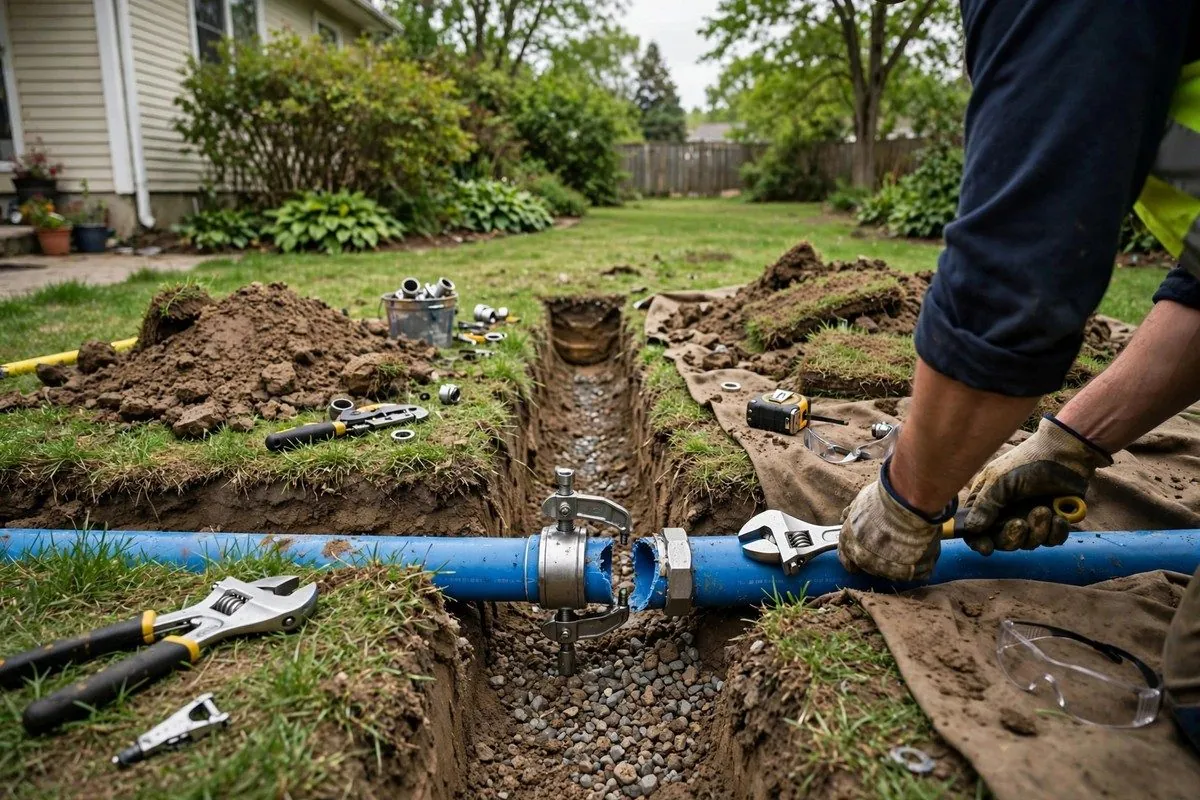
If water is bubbling up in the yard, your pressure has collapsed or the taps have gone dry, treat it as urgent. Our 24/7 line covers water line repair in Simsbury, CT, and same-day visits are available when the schedule allows. While you wait, shut off the main valve inside the house, stay out of the soaked area if wires or outlets are nearby, and note your meter reading.
A water service line is the underground pipe between the main in the street, or your private well, and the first shutoff valve inside the house. It runs through soil, near trees, under driveways and sometimes across a freeze zone, so it ages in ways indoor pipe does not. Repair means fixing a section. Replacement means a new line from end to end.
Water line emergency: what to do before help arrives
Stop the loss and protect the house
A broken buried line can run all night and wash out soil near the foundation.
- Close the main shutoff valve inside the house and see whether the meter dial stops.
- If the dial keeps moving with the inside valve closed, the leak is on the buried line, so tell us and tell your utility.
- Keep children and pets away from soft ground and standing water, especially near an outlet or buried wire.
- Do not dig with machinery before the lines are marked. Call 811 first.
- Call the 24/7 line and describe where the ground is wet.
Three utilities, so find out whose meter and shutoff you have
The Town of Simsbury does not run public water. According to the Town, Aquarion is the provider in most instances, and Connecticut Water and the Tariffville Water Commission also serve parts of town. Homes on private wells are overseen by the Farmington Valley Health District.
The first call is to your own utility. Ask who owns the pipe from the main to the meter, who owns the pipe from the meter to the house, and where the curb shutoff is. Practices differ, and we do not assume a rule that may not apply to your account.
Read the name on your bill or on the meter lid, then ask that office to confirm the ownership line on your property. That answer tells us whether we repair, or whether the utility needs to be involved.
Signs the service line is failing
Wet or sunken ground
A soft patch, a sinking section of lawn or a green stripe in dry weather. Water follows the path of least resistance and may surface far from the break.
Sudden low pressure
The EPA says fixtures work best between 45 and 60 psi, and much lower can point to a leak. Test with a gauge on a hose bibb with everything else off.
High bill, same habits
A bill that climbs with no change in use, or a meter that moves with the house quiet. See a leak survey if you are not sure where the water is going.
Dirty or no water
Discolored water after repairs nearby, or taps that run dry, can mean a broken or blocked line.
Repair or replace the line
The right answer depends on the pipe material, depth and number of failures.
Repair a section
- One accessible break in an otherwise sound line.
- A small excavation, a new section and couplings.
- Lower cost and shorter disruption.
- Risk that old pipe fails elsewhere within a short time.
Replace the whole line
- Old galvanized or lead pipe, or repeated failures.
- A new continuous line from the connection to the house.
- Larger job, but fewer surprise leaks afterward.
- Needs coordination with your utility where the line meets their pipe.
Yard flooding or taps dry?
The 24/7 line is open, and same-day visits are available when the schedule allows.
Trench or trenchless
Both methods end with a new buried line. They disturb the yard in different ways.
| Method | How it works | Trade-off |
|---|---|---|
| Open trench | A trench is dug along the old line and the pipe is replaced in place | Simple and visible, but lawn, driveway or landscaping may need restoring |
| Pipe bursting or pulling | A new pipe is pulled through as the old one is split apart, using small entry pits | Less digging, but needs a straight path and a pipe that can be pulled |
| Spot dig and splice | Only the damaged section is exposed and replaced | Quick for a single break, no help for an aging line |
| Directional boring | A new line is drilled underneath hardscape or obstacles | Avoids cutting a driveway, but needs room for entry and exit pits |
Call 811 before anyone digs
By law anyone using power or mechanized equipment to dig must notify Call Before You Dig at least two full business days beforehand, by calling 811. A homeowner using power equipment follows the same rule, and if you hire a contractor to excavate, the contractor makes the call. The service is free and marks buried lines in standard colors.
Gas, electric, telecom and sewer lines can all share the same yard. Ask us about the schedule, since emergency work may start with exposing and hand digging while markings are requested. We do not override the notification rule.
Lead service lines and the inventory
The EPA says lead pipes are more likely in older cities and in homes built before 1986, and the federal ban on installing new lead pipe came in 1986. Under the EPA's 2024 lead rule changes, most water systems must replace lead service lines within 10 years and keep public inventories. The first inventory was due October 16, 2024, with a baseline inventory due November 1, 2027.
Aquarion's 2025 report for Simsbury says it treats the water to reduce the risk of lead leaching, and one sample location exceeded the lead action level. Ask your utility whether your line has been inventoried, what material it is, and whether any replacement program applies. If we expose the line during a repair, we will tell you what we see.
Do not assume your pipe is safe or unsafe by its age alone. A water test is the practical check for any home.
Private wells: line from the well to the house
If you have a private well, the buried line runs from the well and pressure tank to the house, and sometimes onward to a barn. A leak there can make the pump run constantly, drop pressure or leave you with no water. Private wells are under the Farmington Valley Health District.
The CT Department of Public Health suggests testing well water after any repair or replacement of the well, pump or pipes. Pump and water-conditioning specialists hold their own license classes in Connecticut, so ask who is working on the pump itself.
How a water line visit runs
Confirm the loss
We check the meter, pressure and shutoff valves to confirm the line is the problem.
Locate and mark
Listening gear and the utility markings narrow where we need to dig.
Price, then work
You get a clear price before work starts. Then we repair or replace, and pressure test the new section.
Restore and report
We backfill, restore the area as agreed and give you notes on what was found.
What shapes the price of water line work
We do not publish prices because every line is different.
A broken buried line may or may not be covered by your homeowners policy, and some insurers sell separate service-line coverage. Check with your carrier, and ask us for your real number before work begins.
What we do not handle
We do not repair the utility's main in the street or their meter. We do not remove trees, rebuild driveways or pour new concrete beyond basic patching. A leaking main, a broken curb valve on the public side or a meter fault is for the utility to fix.
If the problem turns out to be a sudden indoor split, see burst pipe repair. Soggy ground that comes from the drain side is a different problem, and sewer line repair covers that. Nearby, Avon homeowners can reach the same line.
Frequently Asked Questions
Yes. The 24/7 line takes calls for broken service lines overnight and on weekends, and same-day visits are available when the schedule allows. Close the main valve inside the house while you wait.
It depends on your account and your utility, so ask. Aquarion, Connecticut Water and the Tariffville Water Commission each have their own practices, and we do not assume a rule. Ask where their responsibility ends.
Close the main valve inside the house. If the meter keeps moving, the leak is on the buried line. If it stops, the leak is inside.
Often, yes. Pulling a new pipe through the old path, or boring under a driveway, needs only entry and exit pits. Some lines do not suit these methods, so we check the layout first.
Yes. Connecticut law requires notification before digging with power equipment, and the contractor makes the call if you hire one. The service is free, and we plan the dig around the markings.
We can replace a lead line on your side when it is part of the job. Ask your utility about inventories and any program, since they need to coordinate the connection at their pipe.
- Town of Simsbury water FAQ
- Connecticut PURA, Call Before You Dig and homeowners
- EPA, Basic information about lead in drinking water
- EPA, Lead and Copper Rule Improvements fact sheet
- EPA, Service line inventory fact sheet
- Aquarion 2025 Simsbury Regional water quality report
- CT DPH, Private well testing fact sheet
- 2022 Connecticut State Building Code (2021 IPC plumbing edition), CT DAS Office of State Building Inspector