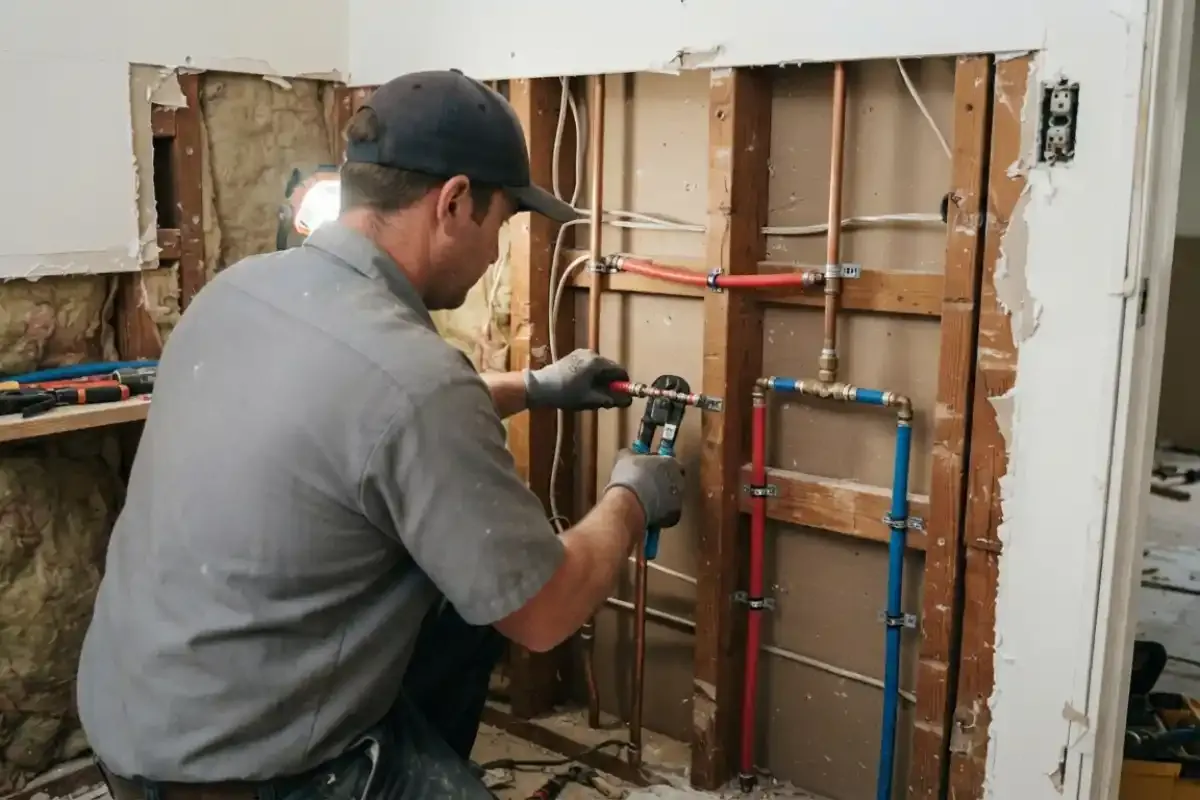
Repiping in Simsbury, CT means replacing the water supply lines inside your home, either the whole system or a section such as a kitchen, a bathroom wing or the run to one floor. The drain, waste and vent pipes are a different system and are not part of most repipes. The goal is steady pressure, clean water at the tap and an end to leaks that keep coming back.
Not every leak means repiping. One failed joint or a bad valve is a repair. A pipe that keeps leaking in new places, brown water, falling pressure and walls that show fresh stains are what push people toward replacement. If a leak is active right now, our 24/7 line is open and we can stop the damage first and discuss repiping afterward.
We judge each house by the pipe in front of us. A pressure test and a camera give better answers than guessing from the year a house was built.
Signs your supply pipes are near the end
Repeated pinhole leaks
Green stains, white crust or a tiny spray on copper, then another leak a few feet away a few months later. One pinhole is a repair. A pattern is a warning.
Falling pressure
Showers that fade when a second tap opens. Old galvanized steel can narrow inside as rust and scale build up.
Rusty or brown water
Orange or brown water at the tap after it sits can mean steel pipe is corroding from the inside.
Visible corrosion
Flaking, bulging or discolored pipe at the water heater, in the basement or near shutoffs.
Galvanized, copper and other older materials
Galvanized steel is zinc-coated iron pipe that was common in older houses. Over time the coating wears off and rust and mineral scale build up inside, which cuts flow and eventually leads to leaks. These lines are usually good repiping candidates.
Copper is long-lived, but it can develop pinholes where water chemistry, flow speed or the pipe wall itself breaks down. If your plumber finds pinholes in several rooms, replacement is often cheaper than chasing each one. Other older materials, including plastic types that are no longer sold, deserve a look as well.
Why the lead solder date matters
Federal law prohibited non-lead-free pipe, fittings, fixtures, solder and flux in drinking water plumbing after June 1986, and the EPA says lead solder and brass faucets are the usual problem in homes without lead service lines. If your house predates that, soldered copper joints are worth a water test.
A repipe with lead-free materials removes the question for the supply lines it replaces. It does not change the service line outside, which is a separate job.
Your water supplier and your pipes
Simsbury has three public water suppliers. According to the Town, Aquarion is the provider in most instances, and Connecticut Water and the Tariffville Water Commission also serve parts of town. Private wells are overseen by the Farmington Valley Health District.
Ask which one you have and request its water quality report. Aquarion's 2025 Simsbury Regional report lists average hardness of 10 grains per gallon, ranging 4 to 16, and an average pH of 7.5. Use those numbers as background only. A pressure test and a camera look at the pipe tell you more about your own plumbing than a town average does.
PEX or copper: how they compare
Both are accepted choices for new supply lines. The right pick depends on the house and your priorities.
| Factor | PEX | Copper |
|---|---|---|
| Installation | Flexible tubing that snakes through walls, so fewer openings | Rigid pipe that needs more fittings and straighter runs |
| Joints | Crimp or expansion fittings | Soldered or press-fit joints |
| Freeze tolerance | Flexes a little when water freezes, though it can still fail | Rigid and more likely to split |
| Look and feel | Color-coded plastic, hidden in walls | Traditional metal, visible in basements |
| Water at the tap | Plastic does not corrode, so no pinholes of that kind | Metal that can corrode over decades |
| Preference | Often chosen for speed and fewer wall openings | Often chosen where owners want metal throughout |
Pipes leaking again?
We can stop the damage today and talk repiping after. The 24/7 line is open, and same-day visits are available when the schedule allows.
What repiping involves in an occupied home
Water will be shut off during the work, so plan on a stretch without water in the house. We do the job in stages where we can, tying new lines to working sections, and we tell you when the taps will be off in each stage. We do not promise a day count, because it depends on the house.
Most of the work happens in the basement, attic or crawlspace. Where pipes run through finished walls and ceilings, we cut small, neat access holes in drywall and leave them ready for patching. Painting and drywall finishing are done by another trade.
A plain-terms timeline
A small partial repipe may be done in a day. A whole-house job usually takes several days, longer for large or finished homes. We give you a realistic window when we see the pipes, and we update you if we find a surprise behind a wall.
Spot repair or full repipe: how to decide
The cheapest fix today is not always the cheapest over five years.
Stay with repairs when
- The leak is a single failed joint or valve.
- The pipe is otherwise sound when inspected.
- A pressure test holds and a camera shows clean pipe.
- You plan to sell or renovate soon and want a smaller job.
Plan a repipe when
- You have had several leaks in different places.
- Water is rusty or pressure keeps dropping.
- The pipe is galvanized steel or shows widespread corrosion.
- You are already opening walls for a remodel.
Before you choose, get findings in writing
Pressure test
We isolate sections and see which lose pressure, which shows whether the problem is local or widespread.
Camera and visual check
Where accessible, an inspection camera and a walk through the basement and attic show corrosion and sag.
Map the scope
We note which fixtures and walls would be touched in a whole or partial repipe.
Price, then decide
You get a clear price before work starts, so you can compare it with spot repairs.
How to compare repiping quotes
- Make sure each quote lists the same material, PEX or copper, and the same fittings.
- Ask what is included for drywall access and who patches it.
- Check whether main shutoff and pressure regulator replacement are included.
- Ask how the work is staged and when the water will be off.
- Verify the license of whoever is signing the quote with the state eLicense lookup, since Connecticut requires a plumbing license for this work.
- Ask whether a permit and inspection are needed and who handles them, and confirm with the Simsbury building department.
What shapes a repiping price
We do not publish prices because every house is laid out differently.
Some insurers cover sudden pipe failure but not wear and tear, so a planned repipe is usually not covered. If a recent leak caused damage, ask your carrier what applies. Then ask us for your number.
What repiping does not fix
Repiping will not cure slow drains, a bad sewer line or a failing water heater. If the problem is a buried line to the house, see service line work. If you are not sure where a leak is, a leak survey can save a lot of drywall.
If you are comparing neighboring towns, Bloomfield and Windsor have Census-based housing-age figures on their pages, which some homeowners use as background.
Frequently Asked Questions
Look for repeated leaks in different spots, falling pressure, rusty water or widespread corrosion. A pressure test and a visual check separate a local failure from a worn-out system. One bad joint is a repair.
It depends on the house. We stage the work so you are not without water the whole time, and we tell you when each shutoff happens. We do not promise a day count before seeing the pipes.
Both are accepted for supply lines. PEX installs with fewer wall openings and does not corrode like metal. Copper is rigid and traditional. Choose based on access, preference and how the quote compares.
We cut small access holes only where needed and leave them ready for patching. Drywall finishing and painting are done by another trade.
Yes. A partial repipe replaces one run, such as a bathroom wing, a floor or the line to the water heater. It makes sense when the rest of the pipe tests sound.
Ask the Simsbury building department, since we cannot state their rule here. Whoever does the work must hold a Connecticut plumbing license, which you can check on the state eLicense site.
- Town of Simsbury water FAQ
- Aquarion 2025 Simsbury Regional water quality report
- EPA, Use of lead free pipes, fittings, fixtures, solder and flux
- EPA, Basic information about lead in drinking water
- Connecticut eLicense lookup
- 2022 Connecticut State Building Code (2021 IPC plumbing edition), CT DAS Office of State Building Inspector