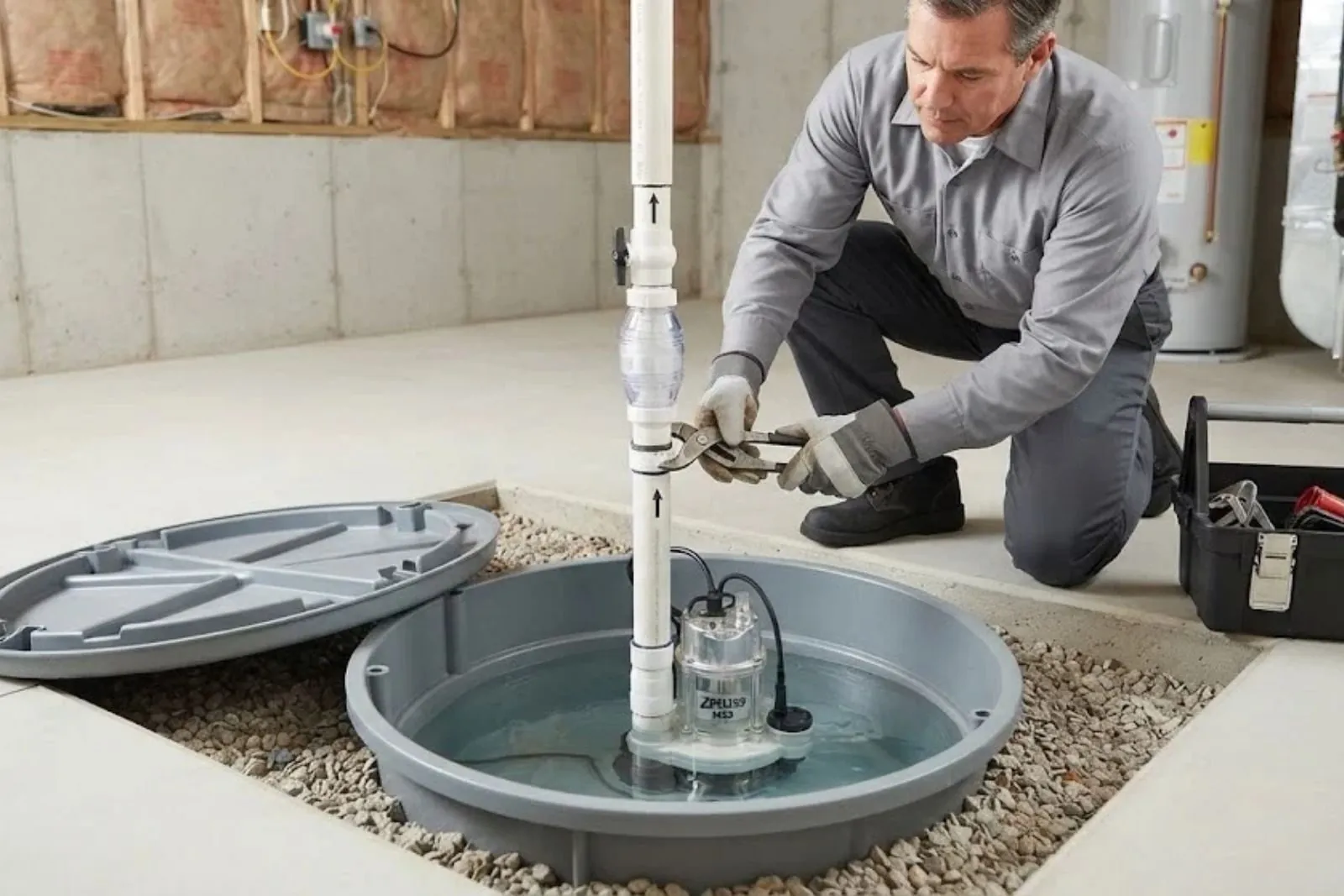
If water is rising in the pit or spreading across the floor, do not wade in. While you wait for us, keep clear of anything plugged into a wet outlet, move belongings off the floor and call our 24/7 line. Same-day visits are available when the schedule allows, and emergency sump pump repair in Simsbury, CT is one of the calls that cannot wait for a business day.
A sump pump sits in a pit, usually the lowest spot in the basement or crawlspace, and pushes groundwater out through a discharge line before it reaches the floor. The system is a pump, a float switch, a check valve and a pipe outside. Any one of those failing leaves you with a pit that fills and a basement that follows.
Basement flooding right now: electrical safety first
Before you touch anything
Water and electricity do not mix, and a flooded basement often has outlets, a panel or a water heater at floor level.
- Do not stand in water to unplug the pump or operate a breaker or fuse box. A municipal utility district advises never to operate or disconnect electrical equipment or a main fuse box while standing in water, and to call the electric utility if power must be shut off.
- If the panel is dry and you can reach it without stepping in water, switch off power to the basement circuits.
- Close the main water valve if a pipe, not groundwater, is the source.
- Move valuables, boxes and electronics upstairs and off the floor.
- Call the 24/7 line and tell us whether the pump is humming, silent or running without moving water.
Why Simsbury basements get water in storm season
Simsbury sits mostly in the Farmington River watershed, according to the Capitol Region hazard mitigation plan. Tropical Storm Irene on August 27, 2011 closed Route 185 at East Weatogue Street, and Route 315 was closed, isolating the Tariffville Village area. Check that your pump runs before a storm like that, because roads and electric service can fail together.
Storm Alfred, the October 29, 2011 snowstorm, left about 830,000 customers without power statewide, some for nearly two weeks. Tropical Storm Isaias in August 2020 left about 3,000 Eversource customers in Simsbury out on the August 5 update. A pump with no power is not a pump, so a backup matters as much as the main unit.
In the summer 2021 storms, the hazard plan says small drainage systems were overwhelmed and Lucy Brook overtopped East Weatogue Street. Ground that stays saturated feeds the pit faster, so a pump that coped last year may not keep up this year.
Signs the pump is failing
Runs but moves little water
A loud motor with a thin flow often means a jammed impeller, a clogged intake or a failing motor.
Never shuts off
A float switch stuck up or tangled on the pit wall keeps the motor running until it burns out.
Won't start
A tripped GFCI, a dead switch or a seized motor. Always check the outlet before assuming the pump is bad.
Short cycling or loud thumps
A bad check valve lets the discharge pipe drain back into the pit. The pump restarts constantly and the hammer shakes the pipe.
Old and untested
Pumps wear out. If yours has never been tested, treat it as unproven until it is.
How we diagnose a pump problem
- Pour water into the pit and watch the float lift, the pump start and the water leave the discharge line.
- Check the electrical circuit, GFCI and cord for damage.
- Look at the check valve for backflow and the discharge pipe for kinks or freezing.
- Measure the pit and compare it to the pump's capacity and the amount of water it must handle.
- Test the backup, including battery charge and whether it triggers at the right level.
Pit full and pump silent?
The 24/7 line is open, and same-day visits are available when the schedule allows.
Primary pump, battery backup or water-powered backup
A backup is not a luxury in a storm town. The right type depends on your household water and how long outages last.
| Option | How it works | Trade-off |
|---|---|---|
| Primary pump only | One electric pump in the pit | Fails when power fails or when the pump does |
| Battery backup | A second pump runs from a battery when power is out | Runs for a limited time, and the battery needs testing and replacing |
| Water-powered backup | A pump driven by pressure from the household supply | No battery, but needs municipal pressure and does not suit private wells |
| Generator-powered | A generator keeps the primary pump running | Needs fuel, safe placement and someone to start it |
Pit, discharge line and check valve details
A pit that is too small makes the pump start and stop constantly, which wears it out fast. A pit that is deep and wide enough gives the pump time to rest between cycles. We size it to the water you actually get, not a rule of thumb.
The discharge line should carry water well away from the foundation and not toward the neighbor's yard or onto the septic field. The EPA says to keep roof drains and sump pumps away from a drainfield, and to make sure the ground slopes away from the building. Ask the Simsbury building department if you are unsure where the line can go.
A check valve in the discharge line stops water from running back into the pit. They fail quietly and are a small part to swap, so test them every time you service the pump.
What happens on a sump pump visit
Safe start
We check for electrical hazards and stop any ongoing flow before we touch the pump.
Test and find
We run the pump, check the float, check valve and discharge, and see how fast the pit refills.
Price, then fix
You get a clear price before work starts. Then we repair or replace the pump, switch or valve, and add backup if you want it.
Retest
We run it again with water and show you how to test it yourself.
A testing routine that takes five minutes
The UConn Extension advises checking that your sump pump works before heavy rain. Do it every season and before a forecast storm.
- Pour a bucket of water into the pit and watch the pump start, empty it and shut off.
- Look at the outside end of the discharge line for ice, debris or crushed pipe.
- Unplug the primary pump and make sure the backup starts.
- Check the battery charge and replace it on the maker's schedule.
- Keep the pit cover on and clear of dirt, stones and debris.
What shapes the price of sump pump work
We do not publish prices because every basement and pit is different.
Insurers treat groundwater seepage differently from a pipe that bursts, and many policies exclude seepage and sewer backups unless you buy an endorsement. Check your policy, and ask us for your real number before work begins.
What a pump cannot do
A sump pump manages groundwater at the pit. It does not seal cracks, stop seepage through walls or fix a bad grade outside. For that, see waterproofing options and have a foundation specialist look at structural cracks.
If the water in the basement is sewage, stop using drains and call us for sewer line repair or drain cleaning. Neighbors in Canton and Granby can call the same 24/7 line.
Frequently Asked Questions
Yes. The 24/7 line takes sump pump calls during storms, overnight and on weekends, and same-day visits are available when the schedule allows. Keep clear of wet outlets and the panel while you wait.
Stay out of standing water, check that the outlet or GFCI has power from a dry spot, and move belongings off the floor. If it will not restart, call us. Bailing with a bucket buys time while you wait.
It varies with use, water quality and the pump itself. A pump that runs often wears faster, and one that has never been tested is an unknown. Replace it if it is noisy, slow to start or has needed repeated repairs.
In a town with a history of storm outages, a backup is worth considering. Battery units run for a limited time, and water-powered ones depend on municipal pressure, so private-well homes should ask about other options.
That usually means the check valve is letting the discharge pipe drain back, or groundwater is higher than you think. We can test the valve and watch the pit refill.
Usually, if it carries water well away from the foundation. It should not go toward a septic drainfield or a neighbor. Ask the Simsbury building department if you are unsure about a specific spot.
- Capitol Region hazard mitigation plan, Simsbury (2024)
- Capitol Region natural hazards mitigation plan, Simsbury section
- Connecticut Storm Response and Recovery Assessment Group report, March 2012
- Town of Simsbury Isaias outage update, August 5, 2020
- UConn Extension, Preparing for heavy rain
- MDC, Sewer emergencies
- EPA, How to care for your septic system
- 2022 Connecticut State Building Code (2021 IPC plumbing edition), CT DAS Office of State Building Inspector