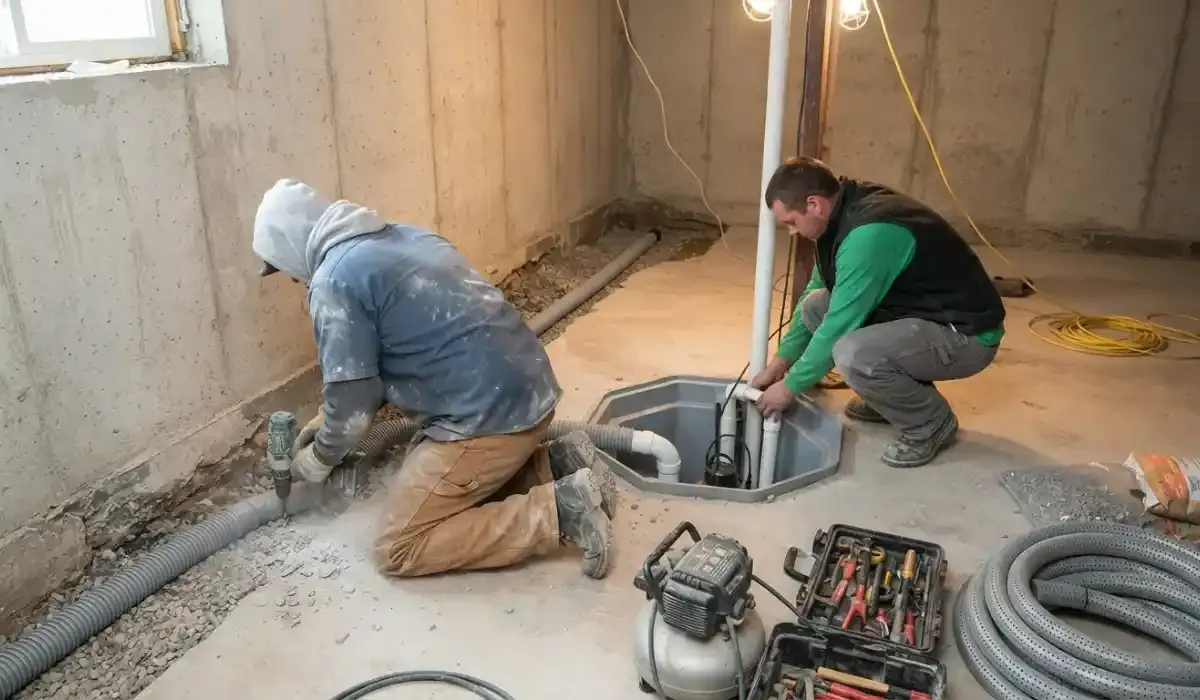
Basement waterproofing in Simsbury, CT is the work of keeping groundwater and surface water out of a below-grade space, or of getting it out fast and safely when it arrives. For a plumber that means drainage, pumps and discharge lines. For a mason or foundation contractor it can mean walls, cracks and exterior membranes. Knowing which problem you have saves money.
Most basements do not flood. They seep. A damp strip along the wall after a rainy week, a white mineral crust on the block or a musty smell in August are the usual warning signs, and they build slowly. If water is actually coming in fast, see our emergency sump pump repair page and call the 24/7 line.
Why basements seep after a wet stretch
Water follows pressure and gravity. These are the usual paths in.
Hydrostatic pressure
When the soil around the foundation is saturated, water pushes against walls and floor, and finds seams, cracks and the joint where the wall meets the slab.
Window wells
A well without drainage or a cover fills in a storm and pours water past the window frame.
Gutters and downspouts
The EPA advises cleaning and repairing roof gutters regularly. A full gutter or a downspout that dumps at the corner puts roof water straight at the foundation.
Grading
The EPA says the ground should slope away from the building so water does not collect. Settled soil or a flower bed that slopes back toward the wall defeats that.
Cracks and wall joints
Hairline cracks may only weep, but they show where water has a route. Structural movement is a separate matter.
What the Farmington River watershed means for your wall
The Capitol Region hazard plan places most of Simsbury in the Farmington River watershed. In the summer 2021 storms it records small drainage systems being overwhelmed and Lucy Brook overtopping East Weatogue Street. Floodwater, per that plan, has also come within feet of the top of the berm at the Water Pollution Control Facility in larger storms.
Those events were about roads and drainage systems, not about any one house, so do not read them as a map of basements. The practical takeaway is simple. If you live near brooks, low ground or the river, watch your basement after every long wet spell and look at the yard drainage before the next one.
Slow seepage versus a flood: which is yours
The fix differs, and so does the urgency.
Slow seepage
- Damp patches that dry out between rains.
- White mineral crust or a musty smell.
- Moisture at the base of the wall or around a floor crack.
- Usually a drainage, grading or gutter job.
Active flooding
- Water on the floor or rising in the pit.
- Failed pump or no power.
- Urgent, with electrical risk if outlets are low.
- Needs emergency help, not a waterproofing plan.
Interior drain tile and sump systems or exterior work
There are two broad ways to deal with groundwater, and often a mix is used.
| Approach | What it does | Trade-off |
|---|---|---|
| Interior drain tile and sump | A perimeter channel under or beside the slab leads water to a pit, and a pump sends it outside | Works from inside with less excavation, but needs a pump and power |
| Exterior excavation and membrane | Dig around the foundation, seal the wall and add drainage outside | Treats the wall directly, but disturbs the yard and costs more |
| Downspout and grading fixes | Move roof water and surface runoff away | Often the cheapest first step, but may not be enough alone |
| Window well drains | Connect wells to a drain or the pit | Stops a common leak point, depends on a working outlet |
Basement damp again?
Call the 24/7 line. Same-day visits are available when the schedule allows.
What a plumber can fix, and what needs a specialist
Plumbing and drainage work
- Sump pits, pumps, check valves and discharge lines.
- Interior drain connections and floor drains.
- Routing downspouts and window well drains to a safe outlet.
- Camera checks of drains for roots or collapse.
Foundation specialist or mason
- Structural cracks that widen, step or bow.
- Bulging or leaning walls.
- Exterior membrane and wall repair.
- Concrete or block replacement.
Moisture testing and dehumidifiers
A simple foil test tells you where moisture comes from. Tape a square of aluminum foil to the wall, seal the edges, and check it after a day or two. Water on the wall side suggests seepage, while droplets on the room side suggest humid air condensing. A moisture meter and a hygrometer give you numbers.
A dehumidifier controls humidity, not leaks. Run it after you have addressed gutters and grading, and keep it draining to a floor drain or the pit so it does not need emptying. The EPA says wet materials should be dried within 24 to 48 hours to prevent mold, so don't leave a damp rug or box on the floor.
How a waterproofing visit runs
Walk the outside
We look at gutters, downspouts, grading and window wells before we go inside.
Inspect inside
We trace damp spots, test moisture and look at the pit, floor drain and pump.
Tell you what is plumbing
We separate drainage and pump fixes from cracks that need a foundation specialist.
Price, then work
You get a clear price before work starts. Then we install or repair the system we agreed on.
How to compare waterproofing quotes
- Ask each contractor to name the source of the water, not just the product.
- Check whether the quote includes a backup pump and a place for the water to go.
- Ask what happens if the system fails in a power outage.
- Get the scope for patching and finishing in writing.
- Be careful with any contractor who proposes a full excavation before checking gutters, grading and the pump.
What shapes the price
We do not publish prices because no two basements are alike.
Insurers treat water seeping into a basement from the ground differently from a burst pipe, and often exclude it as a maintenance matter. Check your policy before assuming coverage, then ask us for your real number.
Where we stop
We do not repair poured walls or block, regrade large areas or remove mold. A bulging or stair-step crack calls for a foundation specialist before any drain is installed. If water in the basement comes from a pipe, see leak detection or burst pipe repair.
Customers in Granby and Windsor can also reach the same 24/7 line. A sewage smell in the basement is a drain problem, and drain cleaning is the place to start.
Frequently Asked Questions
Soil takes time to saturate, and then pressure pushes water through cracks, joints and window wells. Dry spells let it recede. Gutters, grading and a working sump are the first things to check.
No. A plumber handles drains, pumps and discharge. A structural crack that is wide, stepped or bowing needs a foundation specialist. We can still tell you whether drainage is part of the problem.
Neither is always better. Interior systems work with less excavation and rely on a pump. Exterior work treats the wall but disturbs the yard. Many basements only need gutters and grading corrected.
No. It lowers humidity but does not stop water entering. Use it after you have dealt with the water source, and drain it to a floor drain or the pit.
Typically not. Seepage from the ground is generally treated as a maintenance issue and excluded, while a pipe that bursts is different. Ask your insurer what applies to you.
Shut off the main valve and watch the meter. If the dampness continues, the water is likely groundwater. A meter that moves points to a pipe, and a leak survey can find it.