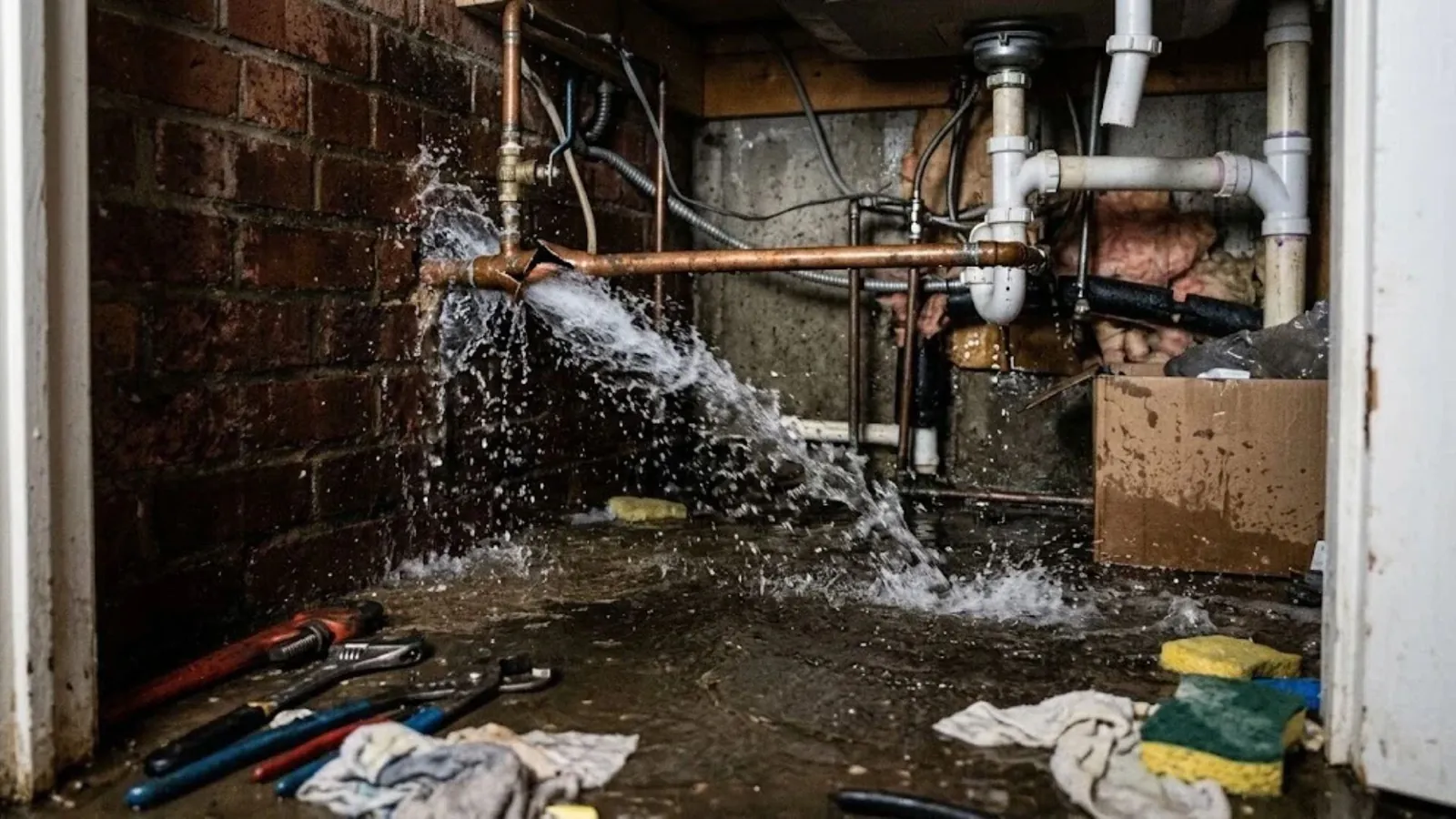
If water is spraying or pouring through a ceiling, stop reading and close the main shutoff valve. Our 24/7 line is open for burst pipe repair in Simsbury, CT, and same-day visits are available when the schedule allows. Keep everyone out of rooms where water meets outlets, light fixtures or a panel, and open a low faucet to drain the lines.
A burst pipe is a split or blown-out joint in a water supply line, usually from freezing, corrosion, age or high pressure. The rupture can be a hairline pinhole or a foot-long tear. Either way, the fix starts with controlling the water and then finding what failed and why.
Burst pipe emergency: shut it down in this order
Speed matters more than neatness. These steps limit the damage before help arrives.
- Close the main shutoff valve. It is usually near where the water line enters the house, often in the basement, a utility room or a crawlspace, and is a wheel handle or a lever.
- Open the lowest faucet in the house and the highest one to drain what is left in the pipes.
- Switch off power to wet areas at the breaker, but only if you can reach the panel without stepping in water. If you cannot, stay out and call us and your electric utility.
- Turn off the water heater at its power or gas control so it does not run dry, then move valuables and rugs out of the puddle.
- Take photos and video of the damage before you clean anything up.
Finding your main shutoff before you need it
In most homes the main valve sits on the wall facing the street, close to the meter or the point where the line comes through the foundation. Slab homes sometimes put it in a closet or garage. If you have a public meter, a second valve may sit in a curb box outside, and your utility can tell you whether you may operate it.
Walk to yours now and turn it fully closed, then open it again. A valve that has not moved in years may be stuck or drip at the stem. Tag it with a bright strip of tape so anyone in the house can find it, and tell us if it will not close.
Burst, frozen or pinhole: three different problems
The cause changes the repair, and sometimes the right trade.
| Type | What you see | Usual cause |
|---|---|---|
| Burst pipe | Water spraying or flowing, wet ceiling, loud rushing sound | Frozen split, blown fitting or sudden pressure spike |
| Frozen pipe | No water or a trickle from a tap, frost on exposed pipe, a bulge | Cold air on an uninsulated line in an outside wall or unheated space |
| Pinhole leak | Green stain on copper, damp spot, small spray, dripping under a fixture | Corrosion from the inside or outside of aging pipe |
| Failed fitting | Weeping at a joint, valve or supply connector | Loose connection, worn washer or failed solder |
Frozen pipes: thaw them without making it worse
NWS guidance says to turn on the faucet first, then warm the pipe with a space heater, a heating pad, a hair dryer or hot water on a cloth. Never use an open flame, and call a plumber if the problem continues. Pipes on exterior walls, in basements, in attics and under kitchen cabinets freeze most often.
Start thawing at the faucet end and work toward the blockage. If a pipe is already cracked, thawing it releases the water, so keep the main valve nearby. If you cannot find where the pipe is frozen, or the ice is behind a wall, stop and call.
Water coming through the ceiling?
Shut the main, then call. The 24/7 line is open and same-day visits are available when the schedule allows.
Long outages: how Simsbury storms put pipes at risk
The October 2011 snowstorm, called Storm Alfred, struck Connecticut on October 29 with about 830,000 customers without power statewide, and some homes stayed dark for nearly two weeks. The Capitol Region hazard plan says it wreaked by far the most havoc on Simsbury. A house without heat during a cold snap can drop below freezing quickly, so do not wait to see what happens.
Tropical Storm Isaias in August 2020 left about 3,000 Eversource customers in Simsbury without power on the August 5 update, and about 8 were still out by August 11. That was summer, so freezing was not the issue, but it shows how long outages can run. Plan for several days, not several hours.
A freeze-prevention routine for a long outage
Shut the main and drain the system if the house will go cold, since pipes without water cannot burst. Open the lowest and highest faucets, flush toilets once, and leave drain traps with a splash of non-toxic antifreeze if you have it.
While the house still holds some warmth, NWS advice is to let faucets drip and open cabinet doors under sinks so warmer air reaches the pipes. NWS also says to keep the heat at 55 degrees or higher when you are away, which is a useful floor to aim for. Close off an unheated room and gather in the warmest part of the house. For a longer outage, a plumber can fully drain the system and the water heater.
How we find the failure and repair it
Once the water is off, the repair depends on the material and how much of the line is damaged.
Spot repair
- Cut out the split section and install a short new piece.
- Copper uses a soldered joint or a press fitting that crimps without a flame.
- PEX uses crimp or expansion fittings and tolerates some freezing better than rigid pipe.
- Best for one failure in otherwise sound piping.
Longer run or reroute
- Replace a full length of pipe when several spots have failed.
- Reroute out of a cold outside wall if the same line freezes every winter.
- More work, but it fixes the cause and not just the symptom.
- If pinholes keep appearing, a repipe may beat repeated patches.
Drying out and documenting for insurance
The EPA says wet materials should be dried within 24 to 48 hours to prevent mold. Start documenting at the same time.
- Photograph the burst, the water line on walls and every damaged item before you move it.
- Keep the failed pipe section if the plumber removes it, since an adjuster may ask to see it.
- Ask the plumber for a written note of what failed, what was repaired and the date.
- Run fans and a dehumidifier, and pull up wet carpet and pad quickly.
- Call your insurer and ask what they require. Standard homeowners policies generally cover damage from frozen and burst pipes, but sewer and drain backups usually need a separate endorsement.
What happens on a burst pipe visit
Control the water
We confirm the main is off, drain the lines and check for live electrical hazards.
Locate the break
We follow wet materials back to the split and check nearby pipes for damage.
Quote and repair
You get a clear price before work starts. Then we cut, replace and pressure test the repair.
Restore and advise
We turn the water back on slowly, check for leaks, and tell you what to dry and who to call next.
What drives the cost of a burst pipe repair
We do not publish prices because every burst is different.
Insurance may cover the pipe repair and resulting damage, depending on your policy and the cause. Ask your carrier what applies, and ask us for your number before work begins.
Keeping it from happening again
- Insulate pipes in exterior walls, attics, garages and crawlspaces, and seal cracks near water lines with caulk.
- Open cabinet doors on cold nights and let a faucet drip on the coldest lines.
- Set the heat no lower than 55 degrees if you are away, and the Insurance Information Institute suggests 65 or higher at home.
- Disconnect garden hoses and shut off outdoor spigots before the first hard freeze.
- If a line freezes more than once, ask about moving it or rerouting it rather than waiting for the next split.
Where this repair stops
We repair pipes. We do not handle the full drying and restoration work after a flood, which is a separate contractor. A burst in the street or on the utility side of the meter is for the utility.
If the failure is on the line to the house, see water service line work. A slow hidden drip that has not burst yet is a job for leak detection, and we serve nearby Granby and Canton on the same emergency line.
Frequently Asked Questions
Yes. The 24/7 line takes burst pipe calls overnight, on weekends and during storms, and same-day visits are available when the schedule allows. Close the main valve and keep clear of wet outlets while you wait.
Look where the water line enters the house, often in a basement, utility room or crawlspace near the meter. It is a round wheel or a lever handle. If you cannot find it or it will not turn, call and we will talk you through it.
Sometimes. Open the faucet, then warm the pipe with a hair dryer, heating pad or hot water on a cloth. Never use an open flame. Stop and call if the pipe is behind a wall, already cracked, or will not thaw.
Standard homeowners policies generally cover frozen and burst pipe damage, but sewer and drain backups usually are not covered without an endorsement. Policies vary, so ask your insurer what they need from you and keep photos.
Often. A split section can be cut out and replaced with a new piece or a press fitting. If the whole run is corroded or has multiple failures, a larger replacement is the more reliable answer.
If the house will go cold, close the main and drain the pipes by opening the lowest and highest faucets. If it stays above 55 degrees, let faucets drip and open cabinet doors. A plumber can fully drain the system for longer outages.
- NWS, Cold weather safety and frozen pipes
- NWS, After the cold
- Connecticut Storm Response and Recovery Assessment Group report, March 2012
- Capitol Region natural hazards mitigation plan, Simsbury
- Town of Simsbury Isaias outage update, August 11, 2020
- Insurance Information Institute, Surviving severe cold weather
- EPA, A brief guide to mold, moisture and your home
- 2022 Connecticut State Building Code (2021 IPC plumbing edition), CT DAS Office of State Building Inspector