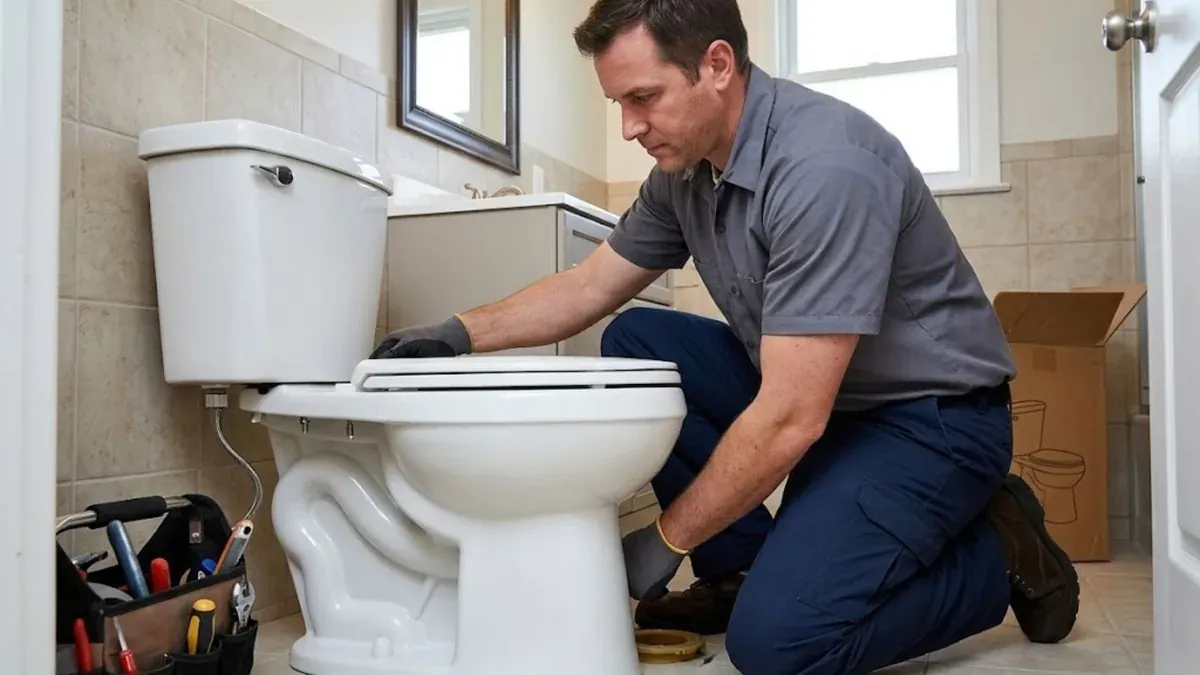
A toilet install comes down to a few connections. Water comes in through a supply line, waste goes out through a closet flange in the floor, and a seal between the two keeps sewer gas and water where they belong. Most of the work is lifting, lining up and tightening without cracking the porcelain.
If the floor is sound and the flange is in good shape, many homeowners finish in an afternoon. The trouble tends to show up after the old toilet comes off, when you find what was hidden under it. This guide covers the full job, the parts that decide success and the points where stopping is the smart move. If you would rather hand it off, toilet repair and installation is something we handle around the clock.
Lay out the tools and parts before you shut the water
- The new toilet, with its tank, bowl, seat, closet bolts and any included hardware.
- A new wax ring or wax-free seal, sized to match your flange and toilet.
- A new braided supply line, and a shutoff valve if the old one is stiff or weeping.
- An adjustable wrench, a putty knife, a hacksaw for long bolts, plastic shims and a level.
- A sponge, a bucket, old towels and a rag to stuff the drain opening while you work.
- Silicone caulk for the base, once the leak test passes.
Installing the new toilet start to finish
- Close the shutoff valve under the tank, flush, and sponge out the tank and bowl until they are nearly dry.
- Disconnect the supply line, then unscrew the nuts on the closet bolts at the base.
- Rock the toilet gently to break the seal, lift it straight up and set it on towels. Expect it to be heavy.
- Scrape off the old wax from the flange and stuff a rag into the drain opening to block sewer gas.
- Inspect the flange for cracks, rust, a loose ring and height, and replace the closet bolts in their slots.
- Place the new wax ring on the flange or the horn of the toilet, as the package directs.
- Lower the bowl straight onto the bolts without twisting, then press down evenly to seat the seal.
- Hand-tighten the nuts, alternating sides in small turns. Stop when it is snug, because over-tightening cracks the base.
- Set the tank per its instructions, connect the supply line and open the valve slowly.
- Flush several times, watch every joint, then check that the bowl is level and does not rock.
Wax ring or wax-free seal
Both do the same job, and the right choice depends on your flange height and whether you might need to pull the toilet again.
Wax ring
- The long-standing choice, and it fills small gaps as it compresses.
- Must be set once and cannot be reused after the toilet is lifted.
- Works best when the flange sits flush with the finished floor.
- Can be doubled or fitted with an extension when the flange is a little low.
Wax-free seal
- A rubber or foam gasket that stays pliable and is easier to handle.
- Can sometimes be reused if the toilet is lifted and reset right away.
- Often forgiving of a slightly off-center set, though it needs a clean flange.
- Check the packaging for flange height limits before you buy.
Toilet leaking or stuck?
Same-day appointments are offered when available, and the 24/7 line stays open.
Closet flange problems that stop a DIY job
The closet flange is the ring on the floor that the toilet bolts to. A bad one cannot be fixed with a thicker wax ring.
Flange sitting below the floor
After new tile or flooring goes in, the flange can end up too low for a normal seal. A flange extension or spacer can raise it.
Cracked or broken ring
A cracked flange cannot hold bolts, so the toilet rocks and the seal leaks. Repair rings and replacement flanges exist, but the pipe has to be sound.
Rotted or soft subfloor
If the floor around the flange is spongy or stained, a slow leak has been working for a while. The wood needs repair before any toilet sits on it.
Flange not fastened to the floor
A loose flange shifts under load. It needs screws into solid framing, not just the wax holding things steady.
Shutoff valve, supply line, leveling and the leak test
A stiff or crusty shutoff valve is a reason to replace it while the water is already off. If it will not close fully, turn off the main and have a plumber swap it, because forcing an old valve can start a leak that is harder to stop.
Level the bowl front to back and side to side. Slip plastic shims under the base at the low spot, tighten gently and trim the shims flush. Then run a dry tissue around each joint after several flushes and again an hour later, since a slow wax ring leak often shows only as a damp spot.
Caulk the base only after the leak test passes. A neat bead around the sides and front keeps mop water out and shows if the toilet ever shifts.
Stop and call a plumber when you see these
Signs the job needs a licensed plumber
These are the usual points where a homeowner should put the wrench down. Moving a toilet to a new spot is a job for plumbing installation, not a swap, and neighbors in Canton and Bloomfield hit the same limits.
- The flange is cracked, rusted through or fastened to a rotted floor.
- The shutoff valve will not close, or the pipe it is attached to moves or weeps.
- The drain was backing up or gurgling before you pulled the old toilet.
- You see water stains or soft wood around the base after the old toilet is out.
- The new toilet rocks and shims do not fix it, or it leaks at the base after a day.
- You plan to move the toilet to a new spot, which means new waste and vent piping.
What Simsbury homeowners should know about doing your own toilet install
Connecticut licenses plumbing work, and the state says no one may perform or advertise licensed work without a license. The statute does exempt plumbing work in or about a single-family home that the person owns and lives in. That exemption comes from the statute itself, not from a Department of Consumer Protection page, and it carries a condition that matters.
The work is subject to inspection and approval by the municipal building official and must meet the State Building Code. In Simsbury that means the Building Department. Its page points to permit guides and an online permit center but does not mention plumbing permits, so we cannot tell you a rule from it. Call before you start and ask whether a toilet swap needs a permit or inspection.
The exemption covers a single-family residence you own and occupy. It does not clearly cover a rental, a unit you do not live in or work you hire out, and anyone you pay has to be licensed. If you hire someone, you can look up their license on the state eLicense site before they begin.
Frequently Asked Questions
Connecticut's licensing statute exempts plumbing work in or about a single-family home that the person owns and lives in, as long as the work is inspected and approved by the municipal building official and meets the State Building Code. Ask the Simsbury Building Department if your job needs a permit, since its page does not mention plumbing permits.
No. Wax compresses to the shape of the first seat and does not seal well a second time. A new ring costs little compared with the water damage from a leak under the floor.
A rocking toilet usually means an uneven floor, a flange sitting too high or too low, or a bolt tightened too much on one side. Plastic shims under the low corner can fix an uneven floor. If shims do not stop it, the flange needs a look.
A first-timer with a sound flange often needs two to three hours, including the leak test. Add time for old flooring, a stuck bolt or a bad shutoff valve.
Close the shutoff valve and wipe the floor dry. A leak at the supply connection often just needs a snug nut, but a leak at the base means lifting the toilet and checking the seal and flange. If you are unsure, call us and we can take over.
- Connecticut General Statutes chapter 393 (plumbing and piping work, sections 20-330, 20-334, 20-340)
- DCP plumbing and pipefitting licensing
- Connecticut eLicense lookup
- Town of Simsbury Building Department
- CT Office of the State Building Inspector, regulations
- 2022 Connecticut State Building Code (2021 IPC plumbing edition), CT DAS Office of State Building Inspector