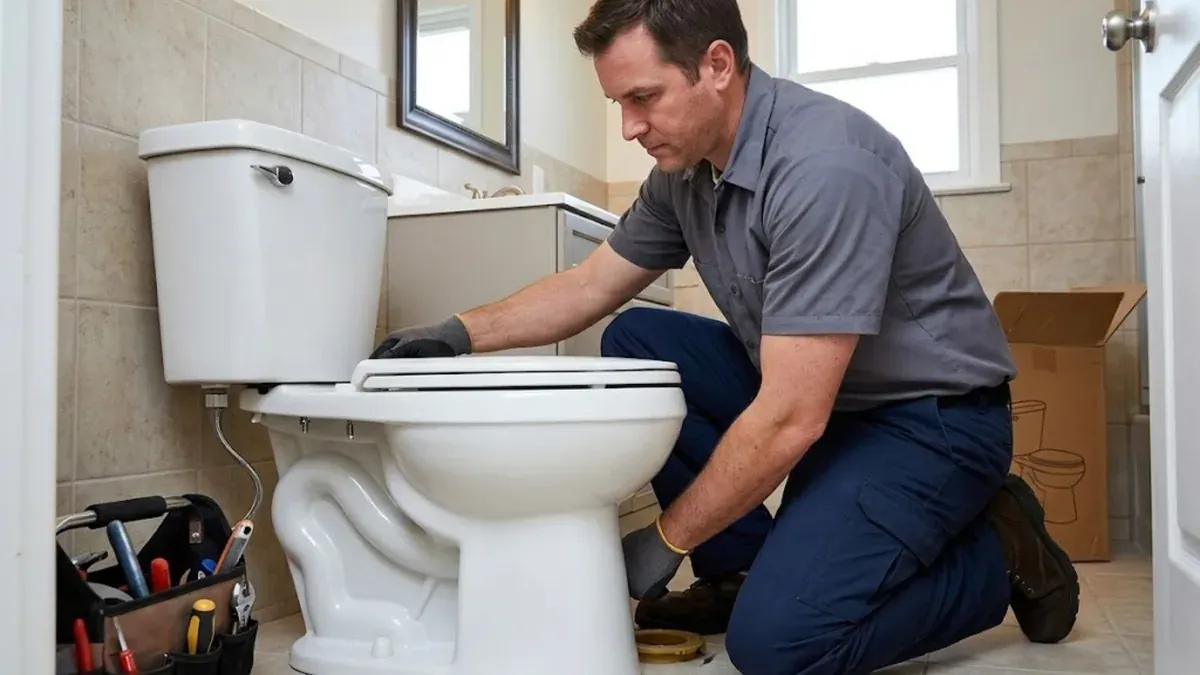
If the bowl is rising toward the rim, stop. Do not flush again. Lift the tank lid, push the flapper down to stop the flow, and turn the oval handle on the supply line behind the toilet clockwise until it stops. Our 24/7 emergency line is open if the water keeps coming or the floor is soaked.
Toilet repair in Simsbury, CT covers the working parts inside the tank, the seal under the bowl and the supply and drain connections around it. It also covers replacing the whole toilet when the porcelain is cracked or the model is worn out. Same-day visits are available when the schedule allows, and a leak at the floor can wait for a daytime slot only if you have shut the supply off.
Most toilet problems are small parts that cost little to replace. The trick is knowing which part, so you do not buy the wrong kit at the hardware store at midnight.
Overflowing toilet: stop the water, then call
A toilet that overflows once is usually a clog in the trap. A toilet that keeps running after the flush is a tank problem. The steps below cover both.
Stop the flow
Lift the tank lid and press the flapper into its seat. If water still rises, close the supply valve at the wall.
Protect the floor
Lay towels around the base and keep children and pets out. Stay away from outlets and cords near wet floors.
Hold off on plunging
Plunge only if the bowl is not near the rim and the water is clear of other fixtures backing up.
Call the 24/7 line
Tell us whether other drains are gurgling too. That points us toward a bigger problem than one toilet.
When a gurgling toilet points to the main line
If the toilet gurgles when the washer drains, or the tub bubbles when you flush, the toilet is probably not the problem. Simsbury's Water Pollution Control office lists slow draining or gurgling, backups in tubs, toilets or floor drains, and all drains backing up at once as signs of a blockage in the main sewer line. In that case we move from toilet repair to drain cleaning and a camera look.
Not every Simsbury home is on public sewer, so ask Water Pollution Control which system you use if it is unclear. On septic, the Farmington Valley Health District covers the system. Plunging will not fix a main-line problem on either, and the same pattern in nearby Avon homes calls for the same camera check.
Toilet overflowing right now?
Our 24/7 emergency line is open, with same-day visits when available.
Finding the real cause of a leak or a weak flush
The symptom usually names the part. Here is how we read it.
| What you see | Likely part | Typical fix |
|---|---|---|
| Water pools at the base | Wax ring or flange | Pull the toilet, replace the seal or repair the flange |
| Tank sweats or drips on the floor | Tank bolts or supply line | Replace gaskets or the braided line |
| Runs on and off by itself | Flapper or fill valve | Replace the worn part |
| Weak, slow flush | Rim jets, trap or low tank level | Descale, adjust the fill level or clear the trap |
| Crack in the bowl or tank | Porcelain failure | Replace the toilet |
Hard water and the fill valve
Aquarion's 2025 report for the Simsbury system lists average hardness of 10 grains per gallon, with a range of 4 to 16. Hard water leaves mineral crust on the seal of a fill valve and around the rim jets, so a toilet can run on or flush weakly even when the part is not worn out. If your toilet hisses after a flush, try cleaning the fill valve seat before buying a new one.
Which utility serves your street can vary, since the Town lists more than one provider. Check your bill, or test your tap, before assuming that number applies at your address. If rim jets are clogged, soaking them in vinegar often helps, and a plumber can clear the stubborn ones.
The dye test and what leaks cost in water
A silent leak does not announce itself. The EPA says to put a few drops of food coloring in the tank, wait 10 minutes, and look for color in the bowl. Flush right after the test so the dye does not stain.
EPA also says household leaks waste nearly 1 trillion gallons nationwide each year, that the average home loses more than 9,300 gallons, and that flappers should be replaced at least every five years. If the dye test fails and the flapper is fine, a meter test will tell you whether the leak is elsewhere. Check the meter before and after two hours of no water use, and if it moves, see leak detection.
Repair or replace the toilet
Repair makes sense when
- The porcelain is sound with no cracks
- The fault is a flapper, fill valve or wax ring
- The toilet is a style you like
- Flush performance was fine until recently
Replace makes sense when
- The bowl or tank has a crack that seeps
- You want elongated or comfort height
- Repairs repeat every year or two
- You are adding a bidet seat and need a new fit
New toilet installs and upgrades
We install the toilet you bought or help you choose one. Old-unit removal is part of the visit.
- Elongated bowls need about two inches more room than round ones, so we check clearance in small bathrooms.
- Comfort height seats sit taller and suit many adults, though they may feel high for small children.
- Bidet seats need a nearby outlet and a tee on the supply line, which we can add.
- A new flange, supply line and shutoff valve are often worth replacing together.
- If you are adding a bathroom or moving fixtures, see plumbing installation.
What shapes the cost of toilet work
We do not publish prices because the part, the toilet and the condition of the floor all change the job. You get a clear price before work starts.
Homeowners policies often cover sudden accidental water discharge but not damage from a long-running leak or maintenance neglect. Sewer backup is usually a separate endorsement. Take photos before you mop and ask your agent.
Honest limits
We replace toilets and repair connections, but we do not repair cracked porcelain, and we do not do tile or flooring work after a rotted floor is found. If water is coming from a faucet or a drain elsewhere, the fix may sit on a different page such as faucet repair, or at the sink under garbage disposal repair.
Frequently Asked Questions
Yes. The 24/7 line takes calls for overflowing toilets, base leaks and supply failures at any hour. Same-day appointments are available when the schedule allows for toilets that are contained but need repair.
Look for a small oval or round valve on the pipe behind the toilet, low on the wall or floor. Turn it clockwise until it stops. If it will not turn, shut off the main water valve and call us.
A worn flapper that lets water seep into the bowl is the usual cause, and the fill valve then refills the tank. The EPA suggests replacing flappers at least every five years.
Yes, if the space allows. Elongated bowls extend farther from the wall, so we measure from the flange and check door swing.
Yes, removal is part of an install visit. Tell us if you have a bidet seat or a special fitting so we bring the right parts.
Sometimes. If other drains gurgle or back up at the same time, the main line is a more likely cause than the toilet. Simsbury's Water Pollution Control lists that pattern as a blockage sign.
Connecticut law lets owners do plumbing work in their own owner-occupied single-family home, subject to inspection by the municipal building official. A bad wax ring seal can ruin a floor, so many owners hire it out.