White or cream PVC pipe turns up in Simsbury basements and crawl spaces as drain lines, vent stacks, sump discharge lines and sometimes cold-water supply. When it leaks, the cause is usually a cracked fitting, a glue joint that never fully welded, or a pipe that has been bent, bumped or left to sag.
Before you reach for the cement, work out whether the pipe carries drain water or pressurized water. That one fact decides how you repair it, how long you wait, and whether a do-it-yourself fix is a sensible idea at all.
Drain lines and pressure lines fail differently
A drain line only carries water downhill, while a pressure line holds constant force against every joint. That gap in stakes is why the two repairs deserve different care.
Drain, waste and vent PVC
- Runs partly full and sloped, so leaks appear only when water flows.
- Wide pipe, usually 1.5 to 4 inches, in thick-walled Schedule 40.
- A weak joint drips under a sink, a toilet flange or a stack.
- Repairs are forgiving, and a slip coupling is a common fix.
Pressure PVC
- Always full and under pressure, so a flaw sprays or soaks the area.
- Carries cold water only, such as sprinkler mains or well lines.
- A failed joint can break loose fully and flood a space.
- Repairs need full cure and a pressure test before the line is buried.
Finding the real source of a PVC leak
Wipe the pipe dry, wrap a dry paper towel around each joint, and run the fixture above it. The first towel to darken marks the leak, though water can travel along a pipe before it drips.
Look for hairline cracks around fittings, which come from overtightened threaded joints or a pipe flexing against a joist. White crusty residue at a joint is a sign of slow seepage.
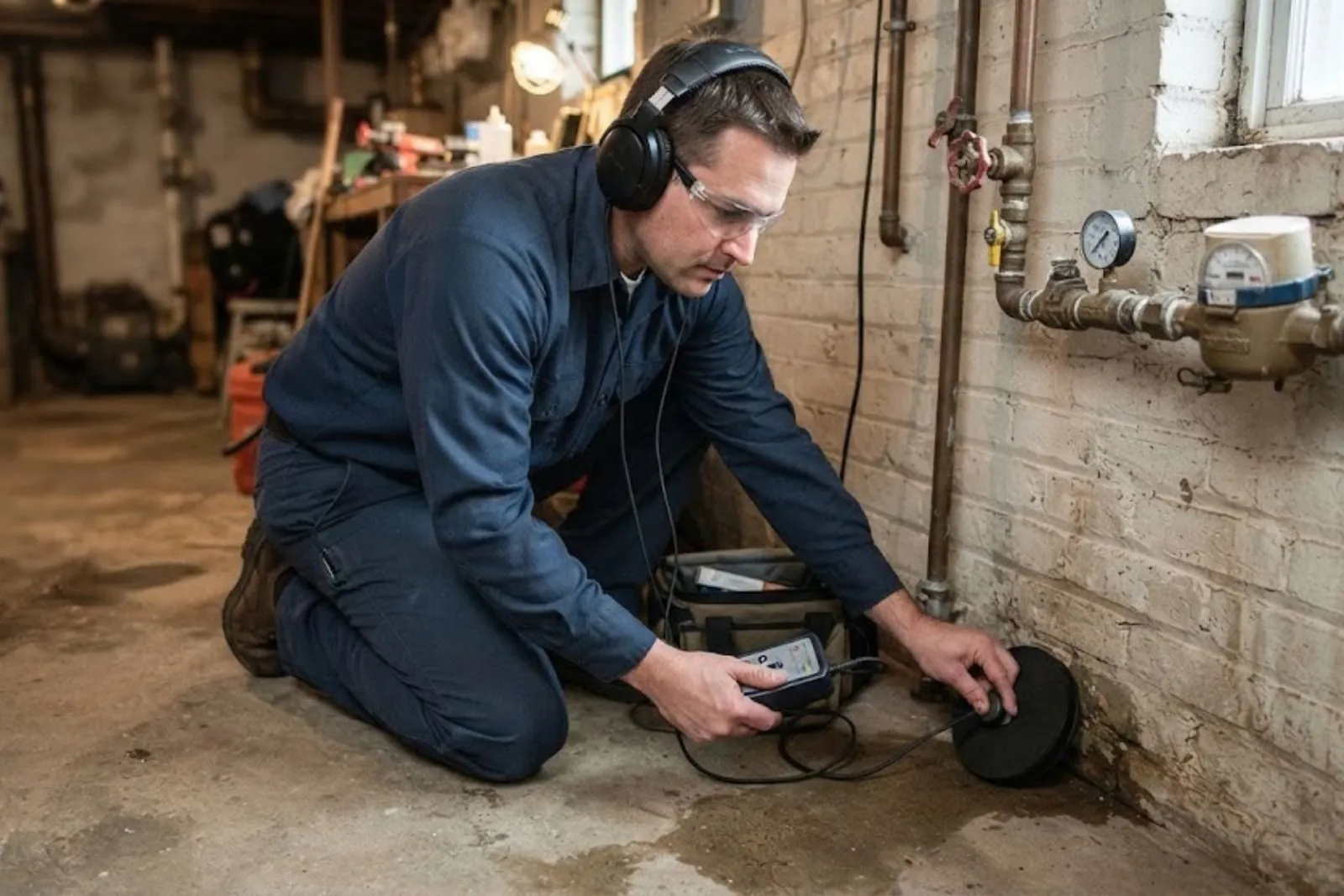
A pressure line that loses water with nothing visible may be buried, in which case leak detection with acoustic or tracer methods finds the spot before anyone digs. If a line has already split and is spraying, treat it as burst pipe repair and close the main shutoff first.
Primer, solvent cement and the weld that makes a joint
PVC joints are not glued the way wood is. Solvent cement softens the surface of the pipe and the fitting so the two plastics fuse into one piece as the solvent evaporates. Primer, usually purple, cleans and softens the plastic first, and it is the step most repairs skip.
Cut the pipe square, remove burrs with a deburring tool, and dry-fit the parts so you know how far the pipe seats. Apply primer to the pipe end and the fitting socket, then cement to both, and push the pipe in with a quarter turn. Hold it for about 30 seconds, because the pipe tends to push back out of the socket.
Cure times depend on pipe size, temperature and humidity, and the can lists them. A cold garage in January needs far longer than a warm basement in August, and pressure on a fresh joint is the most common reason a repair leaks again.
Slip couplings and other ways to repair a cracked pipe
The right repair depends on where the crack sits and how much room you have to work. Replacing a whole run during a remodel is a job for plumbing installation rather than a patch.
| Situation | Repair | Watch out for |
|---|---|---|
| Crack in a straight pipe run | Cut out the section, install a slip repair coupling and a short spacer | A slip coupling needs room to slide, so the spacer must be cut accurately |
| Cracked elbow or tee | Cut out the fitting, install a replacement with couplings | Keep the slope of a drain line the same |
| Leaking glue joint, drain | Cut it apart and rejoin with primer and cement | Cement over a leak does not weld |
| Buried pressure line cracked | Dig, expose, cut out and couple, then test | Check for other utilities first |
Not sure the pipe is safe to fix yourself?
A licensed plumber can look at the line, same day when available, and the 24/7 line is open for floods.
Repair steps for a leaking drain line
This sequence covers a typical cracked section of drain line under a sink or in a basement.
Stop the flow
Shut off water to the fixture, drain the line into a bucket, and let the pipe dry completely.
Cut out the damage
Cut square on both sides of the crack with a ratchet cutter or fine saw, and deburr the ends.
Dry-fit and prime
Test the slip coupling and spacer, then prime and cement every socket, working quickly.
Hold, cure and test
Hold the joint, wait for the stated cure time, then run water and check with dry paper towels.
Pressure testing before the wall closes
A pressure line should be tested before the trench is filled or the drywall goes up. Fill the line slowly, bleed the trapped air at a high fixture, and bring it up to working pressure with a gauge attached at a hose bibb. EPA WaterSense says fixtures work best between 45 and 60 psi, so a reading well outside that range is worth a second look.
Watch the gauge and the joints for a while. A needle that creeps down with every fixture closed means a leak.
Where PVC is the wrong material
PVC is a good, inexpensive pipe in the right place. These are the places where it fails.
- Hot water lines. PVC softens with heat, so hot supply uses copper, PEX or CPVC. DOE suggests setting a water heater at 120 degrees F, and the hot side still belongs on a pipe rated for it.
- Anywhere in direct sunlight. Ultraviolet light makes PVC brittle, so outdoor runs need paint or a shield.
- Compressed air. PVC can shatter violently under compressed air, so never use it for an air line or test it with air.
What Simsbury homeowners should know about PVC repairs, code and digging
Connecticut's 2022 State Building Code is in effect, and its plumbing edition is the 2021 International Plumbing Code with Connecticut amendments dated October 1, 2022. The code applies to new buildings and to those undergoing alterations, additions or changes of use.
Connecticut statute lets a homeowner do plumbing work in a single-family home they own and live in. The work is subject to inspection and approval by the municipal building official and must conform to the code, so ask the Simsbury building department before you cut into a supply line.
Buried lines raise a second question. Anyone excavating with power or mechanized equipment must notify Call Before You Dig at least two full business days ahead, by calling 811. A contractor you hire makes the call, hand digging is encouraged to call too, and the service is free.
Frequently Asked Questions
Epoxy putty or repair tape can slow a drip as a temporary measure, particularly on a drain line. Neither makes a permanent repair, and neither should be trusted on a pressure line.
The lasting fix is to cut out the damaged section and replace it with a slip coupling or a new fitting.
Follow the cure time printed on the cement can, which depends on pipe diameter, temperature and whether the line is under pressure. Drain lines usually need less time than pressure lines.
When in doubt, wait longer, because a joint stressed too early leaks again.
Either the primer was skipped, the cement dried before the pipe was seated, or the pipe was not fully pushed home. A dry joint may look fine and still seep, which is why the pipe is cut out and redone.
Movement from a sagging line or a loose hanger can also open a joint over time.
Ask the building department before you start. The state code applies to alterations, and a licensed plumber knows which repairs need an inspection.
Hire a licensed plumber and ask to see the license, since Connecticut requires one for most plumbing work. Neighbors in Canton and Bloomfield follow the same state code, though each town's building office handles its own permits.
If power equipment will be used to dig, yes, at least two full business days ahead. If you are digging by hand, calling is still encouraged, and it takes a few minutes.
Buried gas and electric lines near a water line are the reason.