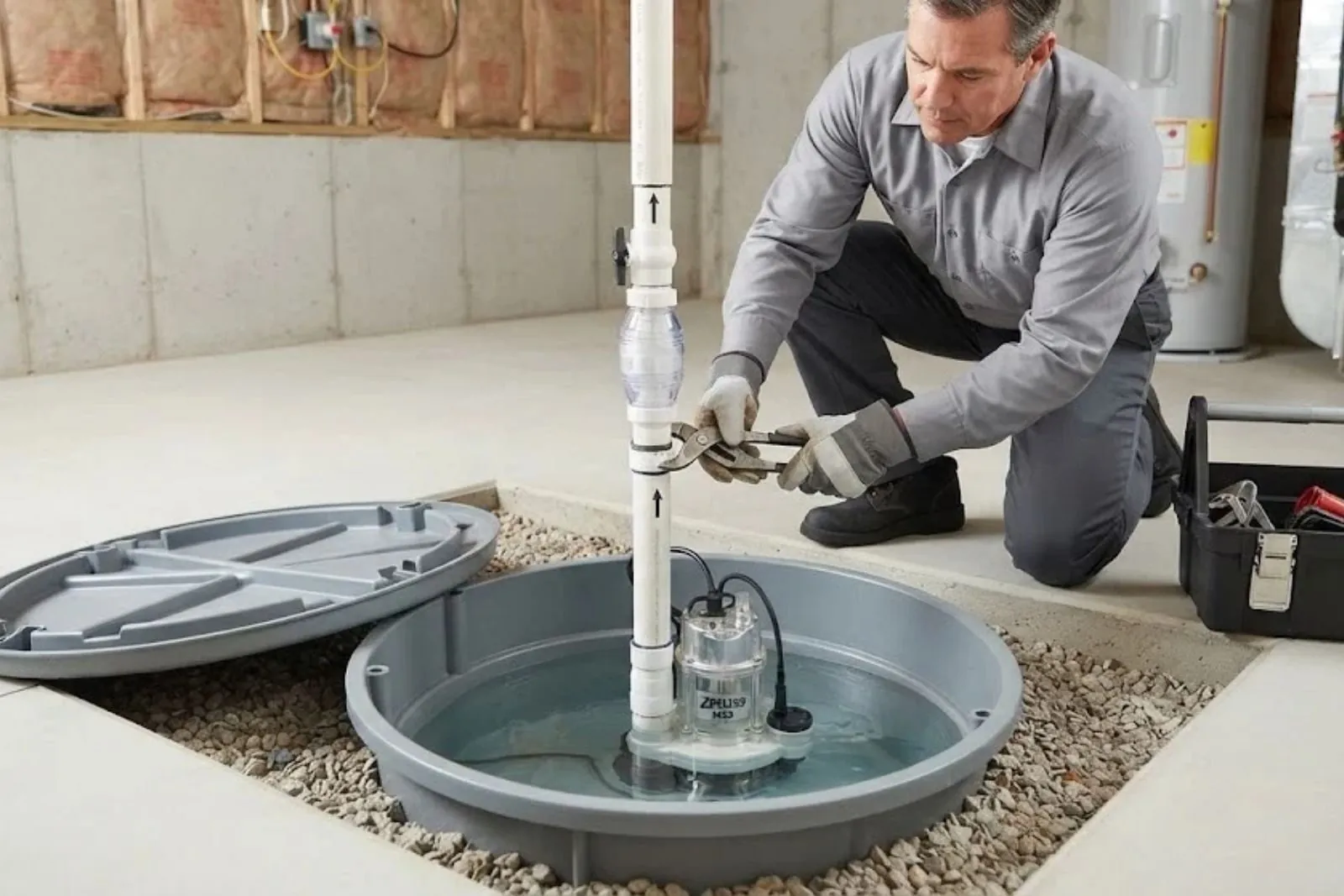
If you are pricing a new sump pump in Simsbury, you have probably noticed that two quotes for the same house can look nothing alike. One may be a pump swapped into an existing pit, and the other a new pit cut into the slab with a battery backup and a buried discharge line. Those are different jobs even though both end with a pump humming in the corner.
We do not publish prices, because they depend on your basement, your yard and the pump you choose. Below is each cost driver, so you can read a sump pump installation quote with confidence. The same logic holds for homes in Granby and Canton.
Where the money goes in a sump pump install
Most of the difference between quotes comes from six drivers. Use this as a map when you read a proposal.
| Cost driver | What changes the work | What to look for in a quote |
|---|---|---|
| Pit and slab work | An existing pit versus cutting the concrete, digging and setting a new liner | Whether the quote says reuse, resize or new pit, and who removes the concrete. |
| Pump type and horsepower | Submersible or pedestal, and how much water it must move | The brand, model and horsepower written out, not just a sump pump. |
| Battery backup | A second pump on a battery, or none at all | Battery size, charger, alarm and how many hours it is rated to run. |
| Discharge routing | Pipe length, check valve, where the water ends up | Where the pipe exits, how far it carries water from the foundation and how it avoids freezing. |
| Electrical | A grounded outlet within reach or a new circuit | Whether an electrician is included and whether the outlet has GFCI protection. |
| Access and cleanup | Finished basements, crawl spaces, hauling debris | Disposal of the old pump, concrete and spoils, and floor patching. |
Pit work: reuse the pit or cut a new one
Swapping a pump into a sound existing pit is the simplest case. A new pit means a saw cut or a breaker in the slab, hand digging, a perforated liner set in gravel and concrete patched back flush. That adds labor, materials and dust control, and in a finished basement it also means protecting or moving what is in the way.
Pit depth and diameter matter too. A pit that is too shallow makes the pump cycle every few minutes, and a cycling pump wears out sooner. Ask what size the pit will be.
Pump type, horsepower and the case for a backup
Submersible pumps sit in the pit and run quietly. Pedestal pumps keep the motor above the water on a column, are easier to reach and tend to be louder. Horsepower is the muscle, and a bigger motor is not always better, since the pump has to match the pit, the lift to the discharge point and how much water arrives. Ask the installer to explain why the chosen size suits your house.
A battery backup is a second pump or a controller that keeps water moving when the power fails. It adds equipment and a battery that will need replacing, but a sump pump with no power is a pit that fills up. Also ask about an alarm that tells you when the pump or battery is in trouble.
Discharge routing: where the water goes
The discharge line carries water out of the pit through a check valve, which stops it from running back in, and away from the foundation. A short run to a yard far enough from the wall is far simpler than a long buried line that has to cross a walkway or reach a drainage swale. Water that comes back to the foundation just loops through the pit again.
Avoid sending sump water to your septic system, since the EPA advises keeping roof drains and sump pumps away from the drainfield. On public sewer, ask the Simsbury Water Pollution Control office before tying the pump into any sanitary line, since the MDC explains that stormwater in sanitary sewers contributes to surcharging. A quote that leaves the discharge point vague is one to question.
Basement taking on water?
Call the 24/7 line. Same-day appointments are available when the schedule allows.
How to compare quotes line by line
Put the proposals side by side and check each of these.
- Scope of the pit. Does each quote say reuse, resize or new, and who handles the concrete?
- Pump model and horsepower, written out, so you can look up the specifications yourself.
- Backup system. Is a battery or second pump included, and what does the alarm do?
- Discharge path. Where does it exit, how is the check valve handled and what happens in winter?
- Electrical work. Is the outlet grounded, GFCI-protected and on a suitable circuit, and who installs it?
- Hauling and restoration. Are the old pump, concrete and debris removed, and is the slab patched?
- Testing. Will the installer pour water in the pit and watch the pump start, run and shut off before leaving?
Why price is not the only number that matters
A lower number can leave out the backup, the check valve or the patched slab, and then reappear as add-ons. It can also use an undersized pump that runs constantly. Compare what you are buying, not just the total.
If water only shows up in storms, the pump's job is rare and critical. Spend where a failure would hurt, which is usually the backup and the discharge line. If water keeps coming even with a good pump, the real fix may be basement waterproofing that controls where it enters.
What Simsbury homeowners should know about storms and sump pumps
Simsbury's own hazard planning records show why the pump and its backup matter. Tropical Storm Irene struck Connecticut on August 27, 2011, and the town's 2014 plan lists Route 185 closed at East Weatogue Street. In Isaias, in August 2020, about 3,000 Eversource customers in Simsbury lost power, and a sump pump with no backup does nothing in that situation.
The October 2011 snowstorm, Storm Alfred, did the most damage to Simsbury of any event in the plan, with about 830,000 customers without power statewide and some out nearly two weeks. A long outage in a thaw or rain is the scenario to plan for, so ask for a backup that can run for hours and a way to check the battery.
In the summer 2021 storms, small drainage systems were overwhelmed and Lucy Brook overtopped East Weatogue Street. If your home sits near a brook or the Farmington River, the pump will see heavy use in those events, and a discharge that dumps water next to the foundation will only send it back. Test the pump before heavy rain, as UConn Extension advises.
Frequently Asked Questions
Simsbury has had several storms that knocked out power for days, including Storm Alfred in October 2011 and Isaias in August 2020. A backup is the part that keeps the basement dry when the grid is down.
If your basement has never taken water and sits high, it is a judgment call. If it has, add the backup.
The Insurance Information Institute says water that seeps into a basement from the ground is excluded under a standard HO-3 policy, and sewer backups are not covered unless you buy an endorsement. Coverage differs by policy, so read yours or ask your agent about water backup coverage before you need it.
It depends on how hard it works, the quality of the pump and whether the float and check valve stay clean. A pump that cycles constantly wears out faster.
Test it at least once a year by pouring water in the pit, and replace it before it fails instead of after the first storm.
Swapping a pump into an existing pit is within reach of many handy owners. A new pit, a buried discharge or new wiring is another matter.
Connecticut allows owners to do plumbing in their own occupied single-family home, subject to inspection by the building official and the State Building Code. Ask the Simsbury building department what applies before starting.
A sump pump moves water out of the pit once it gets there. Waterproofing includes the drains, membranes and wall treatments that control where the water goes first.
Many houses need both, and a plumber can tell you which problem you have.
- Capitol Region hazard mitigation plan, Simsbury chapter (2024)
- Capitol Region natural hazards mitigation plan update, Simsbury (2014)
- CT Storm Response and Recovery Assessment Group final report (2012)
- Town of Simsbury Isaias power outage update (Aug 5, 2020)
- UConn Extension: preparing for heavy rain
- EPA: how to care for your septic system
- MDC Backwater Valve Program
- Insurance Information Institute: am I covered
- 2022 Connecticut State Building Code (2021 IPC plumbing edition), CT DAS Office of State Building Inspector